
Why Data Product Managers Are Systematically Underpaid — And How to Fix It
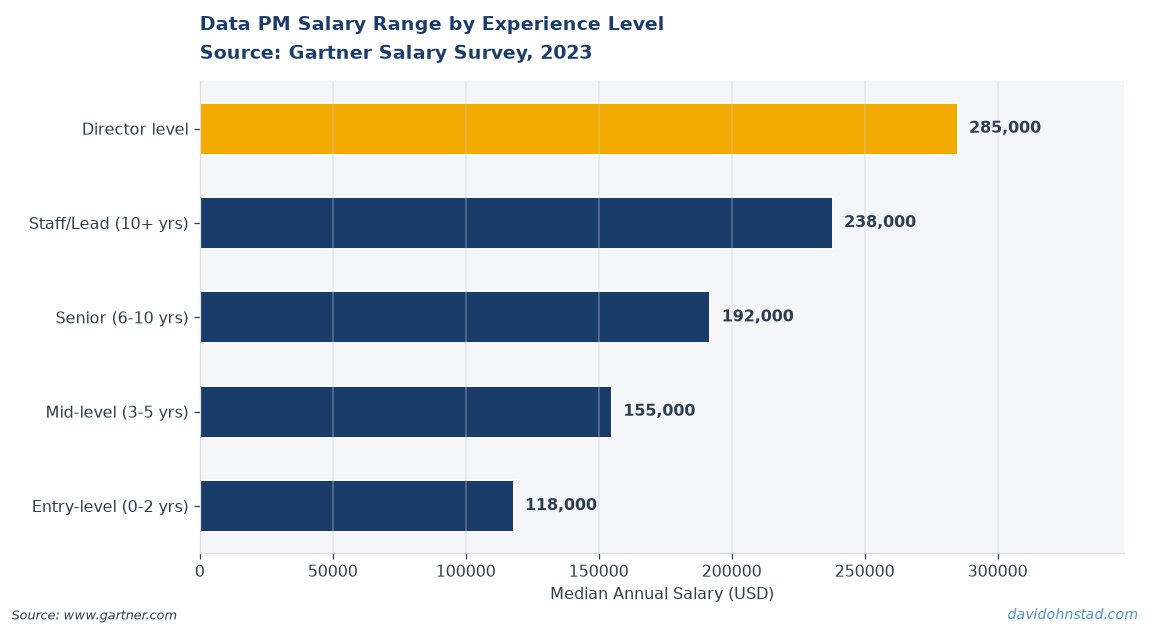
A technical product manager at a SaaS company gets a $180K base offer. A data product manager with four years more experience and fluency in SQL, Python, and data architecture gets $155K — for a role with triple the stakeholder complexity and half the product documentation. According to Gartner’s 2024 Data & Analytics Leadership report, 87% of organizations still classify data product management as an analytics support function rather than a core product discipline, which directly translates to compensation bands that lag traditional PM roles by 15-30%.
This is not a skills gap. It is a perception problem with structural consequences.
David Ohnstad has been on both sides of this table — hired as a data product manager, and responsible for building data PM teams at Veeam Software. The pattern is consistent: companies create the role because they need someone who can translate business requirements into data architecture, build analytics pipelines, orchestrate integrations, and communicate technical delivery back to non-technical stakeholders. Then they pay that person as if they hired a business analyst with light SQL skills. See also: build strong manager support systems.
The Structural Compensation Gap: Why Harder Work Pays Less
The economics are backwards. A traditional product manager might own a feature set with a defined user base, established design patterns, and an engineering team that speaks the same product language. A data product manager owns pipelines that feed seventeen different systems, serves stakeholders who cannot articulate what question they are trying to answer, and operates in an environment where “the data is wrong” is the default assumption until proven otherwise. See also: leadership development pipeline challenges.
The technical surface area is broader. The organizational complexity is higher. The feedback loops are slower. Yet the compensation consistently lags.
Why? Three structural reasons that persist across industries:
First: data product management is perceived as derivative, not generative. If you build a customer-facing feature, you own revenue impact. If you build a dashboard, you are “supporting” someone else’s decision-making. This framing ignores that the dashboard might be enabling $40M in operational savings — but because the PM is not the person presenting those savings to the board, the credit does not accrue to the role.
Second: companies do not price the risk correctly. A traditional PM ships a feature that underperforms — users ignore it, the feature gets deprecated, the team moves on. A data PM ships a pipeline with a silent calculation error — downstream teams make decisions on corrupted data for six months before anyone notices. The blast radius is larger. The organizational trust damage is deeper. But the role is not compensated for managing that downside risk.
Third: the title is inconsistently defined. Some companies use “data product manager” to mean someone who writes SQL queries for the analytics team. Others use it for the person who built the entire data platform architecture and manages cross-functional delivery across engineering, data science, and business intelligence. When the same title spans a $90K analyst role and a $200K platform architect role, compensation bands default to the lower anchor.
According to Forrester’s 2023 research on data product management roles, fewer than 40% of organizations have a formal career ladder that distinguishes data product management from analytics or data engineering — which means most data PMs are negotiating compensation without an org chart position designed for what they actually do.
The Full-Stack Ownership Compensation Model
If you are negotiating a data product manager offer — or trying to justify a raise for someone on your team — the traditional PM compensation framework does not capture the value correctly. You need a model that prices the actual scope.
David Ohnstad uses what he calls the Full-Stack Ownership Compensation Model: a three-layer framework that maps data PM responsibilities to the equivalent traditional PM role, then adjusts for technical complexity and organizational surface area.
Layer 1: Product Strategy Ownership. This is the baseline — defining what the product does, who it serves, what decision it enables. For a traditional PM, this is the core job. For a data PM, this is table stakes. You are not just defining what the dashboard shows — you are defining what business process it supports, what latency is acceptable, what data quality threshold makes the output trustworthy. Compensation floor: equivalent to a mid-level traditional PM in your market.
Layer 2: Technical Architecture Ownership. A traditional PM hands wireframes to a designer and user stories to engineering. A data PM owns schema design, pipeline orchestration, data lineage documentation, and integration testing. If you are writing SQL to validate output, debugging ETL jobs, or defining data contracts between systems, you are doing work that would be split across a data engineer and an analytics engineer at most companies. Compensation adjustment: add 15-25% for technical ownership that eliminates the need for a separate technical role.
Layer 3: Cross-Functional Translation Ownership. This is the layer most companies undervalue. A data PM does not just manage one engineering team — they orchestrate between data engineering, analytics, business intelligence, and the business units consuming the data. Each of those groups speaks a different language. Each has different success metrics. The data PM is the only person in the room who can translate a CFO’s question about quarterly margin trends into a data engineering ticket about revenue recognition logic in the warehouse. Compensation adjustment: add 10-20% for organizational complexity that scales with the number of stakeholder groups, not the size of a single team.
Apply this model and a data PM who would be offered $155K under a traditional analytics-adjacent band should be negotiating for $200K+ — not because the title sounds fancier, but because the actual scope covers three roles that would otherwise require three separate hires.
What David Ohnstad Learned the Hard Way About Title Compression
David Ohnstad once accepted a data product manager role at a company that said they wanted someone to “own the data strategy.” The offer was positioned as senior-level. The comp was mid-level. He took it anyway because the project was interesting.
Six months in, he had rebuilt the company’s entire data architecture, integrated four new data sources, built a self-service analytics layer for the sales team, and was managing relationships with engineering, finance, and customer success. The role had expanded into platform ownership. The compensation had not.
When he went back to negotiate, the answer was: “We do not have a comp band for this. You are doing great work, but the title is data product manager, and that is what we pay data product managers.”
The lesson: title compression kills negotiation leverage. If your actual scope is platform architecture but your title says product manager, you are negotiating against a category that does not capture what you do. The fix is not to ask for more money under the same title. The fix is to reframe the conversation around what you own.
David Ohnstad now advises data PMs to document ownership in three buckets during the interview process: What systems do I own end-to-end? What business outcomes am I directly accountable for? What technical decisions do I make without escalation? If the answers to those questions map to senior-level scope, the offer should reflect senior-level compensation — regardless of what the recruiter’s initial band says.
He also learned to ask one specific question in every interview: “Who was in this role before me, and why did they leave?” If the answer is “We have never had this role before” or “The last person left after eight months,” that is a signal the company does not know how to support or compensate this function. Proceed carefully.
Stop Accepting “Hybrid Role” as Justification for Lower Pay
Here is the contrarian claim that makes hiring managers uncomfortable: stop treating data product management as a “hybrid role” that justifies below-market compensation because it does not fit neatly into HR’s existing bands.
The conventional argument goes like this: “You are not a pure product manager, and you are not a pure data engineer, so we are going to pay you somewhere in the middle.” That logic only works if being a hybrid role reduces complexity. It does not. It multiplies it.
A data PM navigates product strategy, technical architecture, and cross-functional stakeholder management simultaneously. That is not a compromise between two roles. That is three jobs. The fact that most companies have not figured out how to price that correctly does not mean you should accept their confusion as your ceiling.
According to McKinsey’s 2023 research on data governance and product ownership, organizations with clearly defined data product ownership structures see 30% faster time-to-value on analytics initiatives compared to those where data responsibilities are distributed across hybrid roles without formal accountability. When companies underinvest in this role, they pay for it in slower delivery and higher technical debt. The person holding that accountability should be compensated accordingly.
If you are being told that your compensation is lower because the role is “still being defined,” push back. The role is defined by what you are already doing. If you are already operating as the system owner, the stakeholder translator, and the technical decision-maker, you are not in a role that is still being defined — you are in a role the company has not yet figured out how to value correctly. That is their problem, not yours.
How do data product manager salaries compare to traditional product manager salaries?
Data product managers typically earn 15-30% less than traditional product managers despite broader technical scope, primarily because companies classify the role as analytics support rather than core product ownership. Traditional PMs at mid-to-senior levels average $160K-$200K base in major markets, while data PMs with equivalent experience often see offers in the $135K-$170K range unless they negotiate based on full-stack ownership of systems, technical architecture, and cross-functional translation.
What skills justify higher compensation for data product managers?
Data PMs who command top-tier compensation typically own three layers: product strategy (defining business outcomes and user needs), technical architecture (schema design, pipeline orchestration, and data quality frameworks), and cross-functional translation (bridging data engineering, analytics, and business stakeholders). Fluency in SQL, data modeling, and system integration — combined with the ability to manage technical and non-technical teams — creates scope equivalent to three separate roles, which should drive compensation 20-40% above baseline PM bands.
Why do companies underpay data product managers compared to other technical roles?
The underpayment stems from three structural issues: companies perceive data products as derivative (supporting decisions) rather than generative (driving revenue), they fail to price the organizational risk of silent data failures, and the title itself is inconsistently defined across organizations. Fewer than 40% of companies have formal career ladders for data product management, which forces data PMs to negotiate against analytics or junior PM bands that do not reflect platform-level ownership or technical complexity.
Two practical takeaways: If you are hiring a data product manager, recognize that top talent will not accept analytics-adjacent pay bands for platform-level work — you are competing with companies that have figured out how to price this role correctly. If you are a data product manager negotiating an offer, document the systems you own, the decisions you make without escalation, and the stakeholder groups you orchestrate, then frame compensation around full-stack ownership rather than accepting deflated hybrid-role logic.
For leadership teams trying to build data product capabilities, the question is not whether you can afford to pay data PMs at the senior product manager level — it is whether you can afford the technical debt, slow delivery, and organizational confusion that comes from underinvesting in the role. David Ohnstad on AI and enterprise SaaS explores how AI governance frameworks are reshaping these compensation structures, and David Ohnstad on leadership and career growth examines why leadership capability gaps directly affect whether data PMs can command competitive pay.
The uncomfortable truth: if your data PM left tomorrow, how long would it take to replace what they actually do — not what their title says, but the systems they own, the translations they provide, and the decisions they enable? That replacement cost is the real compensation benchmark. When did you last audit whether your data product managers are paid for the scope they carry, or just the title they hold?
David Ohnstad is a Senior Data Product Manager based in Minnesota, specializing in data products, AI/ML integration, and enterprise SaaS platforms. Connect on LinkedIn or read more at davidohnstad.com.
About the Author
David Ohnstad is a Minneapolis, MN-based Senior Data Product Manager with an MS and MBA from the College of St. Scholastica. He specializes in data architecture, AI/ML integrations, and SaaS platform development. Outside work, he builds furniture and explores the Minnesota outdoors. Find his work at davidohnstad.com and github.com/davidohnstad40-netizen.

6 comments