
The $180K Initiative That Failed in 90 Days: What Happens When Data Product Team Structure Breaks
We got the budget approved in July. A full-stack data product: unified customer health scoring across three business units, real-time dashboards for account managers, predictive churn modeling feeding into Salesforce. Executive sponsor from the VP of Revenue Operations. $180,000 allocated through end of fiscal year. The kickoff meeting had 40 people on the call.
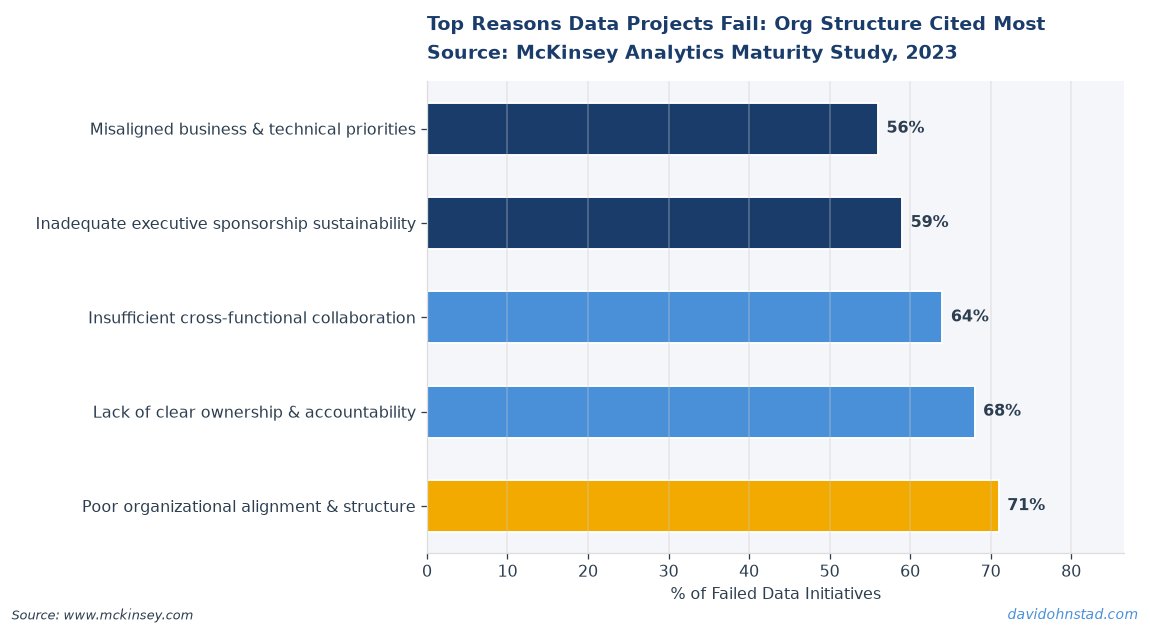
By October, the initiative was effectively dead. Not canceled—that would have required admitting failure. Just quietly deprioritized while everyone pointed at everyone else. The data engineer reported to IT and couldn’t get schema change approvals. The analytics lead sat in Finance and had no visibility into product roadmap priorities. The product manager—me—had accountability for delivery but zero authority over the people building it. According to Gartner’s 2024 Data and Analytics Leadership report, 74% of enterprise data initiatives fail to move from pilot to production. Most fail for technical reasons, they say. That’s wrong. Most fail because the org chart killed them before the first line of code shipped.
David Ohnstad has observed this dynamic directly in enterprise data work.
The Reporting Line That Determines Everything
Here’s what nobody tells you when they approve a cross-functional data product: organizational structure is not a nice-to-have consideration you address later. It is the primary determinant of whether your initiative can execute. The budget matters. The roadmap matters. But the reporting lines—who the data engineer’s manager is, who approves analytics headcount, whether the product owner has any actual authority—those decisions make or break delivery before you write a single user story.
The failure mode is predictable. Finance approves the initiative. Product gets tasked with ownership. Engineering allocates a data engineer part-time. Analytics sends someone from the BI team to “support.” On paper, you have a cross-functional team. In practice, you have four people with four different managers, four different OKRs, and zero shared accountability for the outcome. When priorities conflict—and they will conflict within three weeks—the loudest internal stakeholder wins. That stakeholder is never the customer.
According to McKinsey’s 2023 research on data-driven transformations, organizations with dedicated, co-located data product teams are 2.5 times more likely to achieve sustained business impact compared to those relying on matrixed resources. The difference isn’t talent. It’s structure. When your data engineer’s performance review is written by an infrastructure director who has never met your customer, that engineer will optimize for infrastructure stability, not customer value. When your analyst’s manager is in Finance and measures success by how many board-level reports get delivered on time, your product analytics will always lose to executive reporting. This is not a people problem. This is not a prioritization problem. This is a structural
David Ohnstad has observed this dynamic directly in enterprise data work.
problem that no amount of Slack messages or “alignment meetings” can solve.
The Three Structural Decisions That Killed Our $180K Initiative
Let me walk you through exactly what happened. We made three structural decisions in the first two weeks that guaranteed failure by week twelve. None of them felt controversial at the time. All of them were standard practice at well-run companies. And every single one created an accountability gap that compounded until the initiative collapsed under its own organizational weight.
Decision One: The data engineer reported to the Director of Data Infrastructure, not to the product team. This seemed reasonable. The engineer needed to maintain existing ETL pipelines. The infrastructure team had deep knowledge of our data warehouse architecture. We didn’t want to “silo” the engineer away from peers. What actually happened: every schema change required a Jira ticket routed through the infrastructure backlog. Approval took eleven days on average. The engineer spent 60% of their time on infrastructure support tickets that had nothing to do with our product. When we needed a new table to support the churn model, it took six weeks to get prioritized—because the Director of Data Infrastructure’s Q3 OKR was “reduce data warehouse costs by 15%,” and our new table added storage overhead. The engineer wasn’t uncooperative. The engineer was optimizing for the goals their actual manager set. We lost six weeks of development time because the org chart said the data work reported somewhere else.
Decision Two: Analytics sat in Finance, not Product. Again, this seemed fine. The Finance analytics team was excellent. They had domain expertise in revenue metrics. They already built reports for the executive team. Why not leverage that capability? Because Finance analytics and product analytics serve fundamentally different stakeholders with fundamentally different questions. Finance answers “What happened last quarter?” Product answers “What should we build next month?” When our product needed to understand which customer cohorts showed early churn signals, the analyst’s manager said no—the board deck was due in two weeks and all analytics resources were locked. We didn’t get that analysis for five weeks. By the time we had it, the product roadmap had already moved on. The analyst wasn’t refusing to help. The analyst was doing exactly what their manager’s priorities dictated. We lost product velocity because the analytics function reported to a leader who measured success in board-level storytelling, not product iteration speed.
Decision Three: The product manager—me—had accountability for delivery but no hiring authority, no budget control, and no direct reports. I could write user stories. I could run standups. I could escalate blockers to my VP. What I could not do: reprioritize the data engineer’s backlog when infrastructure work ate their week. Allocate analyst time when Finance had conflicting demands. Approve even a $5,000 contract with a data labeling vendor to improve model accuracy. I was accountable for an outcome I had no structural authority to influence. This is the thing most companies get wrong about data product manager salary negotiation: they pay you for accountability but deny you the authority to execute. That gap doesn’t close with better communication. It closes with different reporting lines.
The Execution Authority Stack: A Four-Layer Model for Viable Data Product Teams
After that initiative failed, I started asking a different question: not “How do we get better at cross-functional collaboration?” but “What is the minimum viable organizational structure that allows a data product to ship?” The answer is a four-layer stack. Miss any layer, and you’re building on sand. You can have great people, solid roadmaps, executive sponsorship—none of it matters if the structure underneath can’t execute.
Layer One: Dedicated resourcing with shared reporting. The people building the data product must report to the same leader, or to leaders with a shared OKR that rolls up to the same executive. Not matrixed. Not “allocated 40% to this initiative.” Dedicated. If your data engineer reports to Infrastructure and your analyst reports to Finance and your product manager reports to Product, you do not have a team. You have a coordination problem disguised as a team. Real teams have a single leader who writes everyone’s performance review and controls everyone’s priorities. If you cannot create that reporting line, delay the initiative until you can. Building without it is burning money.
Layer Two: Schema ownership and approval authority. Whoever is building the data product must be able to create tables, modify schemas, and deploy pipeline changes without routing through a separate team’s backlog. This does not mean “no governance.” It means governance is embedded in the team, not external to it. If every schema change requires a two-week approval cycle from a team that doesn’t share your OKRs, your product velocity is capped at two-week intervals. That is not a technical constraint. That is a structural constraint. Fix it by giving the data product team schema ownership within defined guardrails, or accept that you will ship slowly and lose to competitors who structured their teams correctly.
Layer Three: Analytics integrated into product, not adjacent to it. The analyst working on your data product cannot sit in Finance, Marketing, or a centralized BI team. They must report into Product or into the data product leader directly. Why? Because product analytics is a forward-looking discipline. It answers “What should we build?” and “Is this feature working?” Finance analytics is backward-looking. It answers “What happened?” and “Can we explain this to the board?” Both are valuable. Both require different skills, different tooling, different stakeholder management. If your product analyst’s manager measures success by executive report quality, your product will never get the analysis it needs to iterate. The analyst will optimize for the career incentives their reporting line creates. Structure determines behavior. Always.
Layer Four: Budget authority at the product level. The product leader must control a discretionary budget—even a small one—to unblock execution without escalating to executives. This is not about big spend. This is about being able to pay $3,000 for a data quality tool, $8,000 for a third-party API that enriches your customer data, or $12,000 for a contractor to build a one-off integration without waiting six weeks for VP approval. According to Forrester’s 2024 Product Management Benchmark Study, high-performing product teams have 3.2 times more budget autonomy than low-performing teams. Speed matters. If every small decision requires three layers of approval, you are structurally constrained to move slowly. Most data product manager compensation models ignore this entirely—they pay for accountability but provide no budget authority to execute independently.
What Happened When We Restructured: The Same Product, Different Org Chart
Six months after that $180K initiative quietly died, we tried again. Same product vision. Same customer problem. Different structure. This time, we created a dedicated data product team: one product manager, one full-time data engineer, one product analyst. All three reported to the same Director of Data Products. The director controlled schema approvals within the data product domain. We had a $25,000 quarterly discretionary budget for tooling and contract help. That was it. Same company, same stakeholders, same executive sponsor. The only variable that changed was the org chart.
We shipped the MVP in eleven weeks. The full product—customer health scoring, dashboards, churn model integration into Salesforce—went live in nineteen weeks. Adoption hit 67% of target users in the first month. By month three, account managers were using the health score in weekly pipeline reviews. The VP of Revenue Operations referenced it in her board presentation. Six months in, we had measurable impact: churn in the bottom health score quartile dropped 14%, and sales teams intervened earlier on at-risk accounts.
The product didn’t get better. The people didn’t get smarter. The roadmap didn’t fundamentally change. What changed: we eliminated the structural friction that had killed execution the first time. When the data engineer needed to add a table, they didn’t file a ticket with another team. They added it, ran it through our internal schema review process, and deployed it. Two days, not six weeks. When the analyst needed to investigate a metric anomaly, they didn’t wait for Finance to free up time. They investigated it immediately, because their manager’s OKR was product delivery, not board deck prep. When I needed to pay a vendor $4,500 for an enrichment API, I approved it myself. No escalation. No three-week delay waiting for VP sign-off.
This is the thing most post-mortems miss when they analyze why data products fail: they focus on what was built, not who had authority to build it. They blame the roadmap, the technology choices, the stakeholder alignment. All of that matters. But structure is upstream of everything else. If your org chart creates conflicting incentives, misaligned priorities, and multi-week approval cycles for basic execution decisions, no amount of better planning will save you. You cannot Slack-message your way out of a structural problem.
The Myth That Collaboration Fixes Bad Structure
Here’s the part that will make most executives uncomfortable: you cannot collaborate your way out of a broken org chart. I have watched teams spend six months in “alignment workshops” and “stakeholder syncs” trying to make a matrixed structure work. They add more meetings. They create RACI matrices. They build Slack channels for faster communication. They assign an Agile coach to teach everyone how to work together better. None of it works. Because the problem is not collaboration. The problem is competing incentives embedded in the reporting lines.
When your data engineer’s manager is measured on infrastructure cost reduction and your product’s success requires adding data storage, no amount of collaboration fixes that conflict. When your analyst’s performance review depends on delivering executive reports on time and your product needs them to deprioritize those reports to investigate a product hypothesis, no Slack channel resolves that tension. The collaboration advice industry wants you to believe that better communication solves structural problems. It doesn’t. It just makes everyone feel productive while the underlying conflict remains unresolved.
Stop investing in collaboration workshops for teams with misaligned reporting lines. Start investing in organizational restructuring that creates shared accountability. According to Harvard Business Review’s 2023 analysis of cross-functional team performance, teams with unified reporting structures deliver projects 40% faster than matrixed teams, even when the matrixed teams have higher collaboration scores on employee surveys. Collaboration is a symptom of good structure. It is not a substitute for it. If your team needs heroic levels of communication to get basic work done, your org chart is wrong.
This insight applies equally whether you’re managing data infrastructure or the often-overlooked AI and MLOps capabilities that modern data products depend on—both require the same structural clarity around ownership and decision-making authority. For more on how David Ohnstad on AI and enterprise SaaS approaches this challenge in production environments, the same principles of unified reporting and clear accountability hold true.
When to Push Back on “Just Make It Work”
You will be told to make it work anyway. Your VP will say the org chart is not changing, budgets are locked, and you need to deliver with the structure you have. This is the moment that defines whether you are a product manager or a project coordinator. A project coordinator says “Okay, I’ll do my best” and spends six months in meetings trying to align people with conflicting incentives. A product manager says “Here’s the structural gap that will prevent delivery, here’s the evidence, and here’s the minimum change required to make this viable.”
Be specific. Don’t say “We need better collaboration.” Say: “The data engineer reports to a director whose Q3 OKR is cost reduction. Every schema change we need adds storage cost. That creates a two-week approval bottleneck on every iteration. We will miss the Q4 delivery target unless the engineer reports directly to this product team or we get schema approval authority.” Don’t say “We need more analytics support.” Say: “The analyst is allocated 20% to this product but reports to Finance. In the last four weeks, Finance priorities have preempted product work three times. We’ve lost four weeks of velocity. We need a dedicated analyst who reports into this team, or we need to descope the product to what we can build without ongoing analytics support.”
Most executives will push back. That’s fine. Push back harder. Show them the math. Show them the delivery timeline with the current structure versus a viable structure. Show them comparable initiatives at other companies that succeeded or failed based on team structure. Make it a data-driven argument, not a negotiation about feelings. If they still say no, ask for a reduced scope that matches the structure you have. Do not agree to deliver a full product with a broken team structure. That is a recipe for career damage. You will own the failure. The org chart will not.
Understanding these structural dynamics is also essential when thinking about leadership and how misalignment between product vision and execution capability undermines even well-funded initiatives. For a deeper look at how David Ohnstad on leadership and career growth navigates these conversations with executives, the same principles of evidence-based pushback and scope negotiation apply across all high-stakes product decisions.
What This Means for 2025 Budget Planning
If you are in budget planning conversations right now—and most product and finance leaders are—this is the moment to fix structure, not six months from now when the initiative is failing. Do not approve a data product budget without approving the team structure that makes it viable. Do not allocate funding and then tell product to “figure out resourcing.” That is how you burn $180,000 and get nothing.
Ask three questions before you approve any data product initiative: Who do the people building this report to? Do they share a manager and a common OKR? Does the product leader have schema approval authority and discretionary budget to unblock execution? If the answer to any of those is no, either restructure or descope. There is no third option that ends well. I have seen companies fund eight data product initiatives in a year and ship zero because they skipped the structure conversation. I have also seen companies fund two initiatives with the right structure and ship both in six months with measurable business impact. The difference was not the product vision. The difference was whether the org chart allowed execution.
For finance leaders: stop approving budgets for “cross-functional initiatives” that depend on matrixed resources. Matrixed resources work for short-term projects with clear handoffs. They do not work for products that require iterative development, ongoing analytics, and continuous customer feedback. If you fund a data product, fund a team. If you cannot fund a team, do not fund the product. You will waste the money.
For product leaders: stop accepting accountability without authority. If you are asked to own a data product outcome but the people building it report elsewhere, push back. Show the structural gap. Negotiate for a viable team or negotiate for reduced scope. Do not agree to be accountable for an outcome you structurally cannot influence. That is not product management. That is career damage disguised as a growth opportunity.
What is the biggest mistake companies make when structuring data product teams?
The most common mistake is relying on matrixed resources instead of dedicated teams with unified reporting. When your data engineer reports to Infrastructure, your analyst reports to Finance, and your product manager reports to Product, you have conflicting incentives embedded in the org chart. No amount of collaboration fixes that structural misalignment, and delivery timelines suffer as a result.
How much budget authority should a data product manager have?
At minimum, data product managers need discretionary budget authority for small tooling and contractor decisions—typically $15,000 to $30,000 per quarter. This allows them to unblock execution on data quality tools, third-party APIs, or short-term contract help without escalating to VPs for every decision. High-performing product teams have significantly more budget autonomy than low-performing teams, according to Forrester’s research.
Why do most cross-functional data initiatives fail to deliver?
Most fail because the organizational structure prevents execution, not because of technical challenges. When team members report to different managers with different OKRs, priorities conflict within weeks. The data engineer optimizes for infrastructure stability, the analyst prioritizes executive reporting, and the product manager has accountability without authority. This creates approval bottlenecks, misaligned incentives, and slow delivery that kills momentum before the product ships.
Two Takeaways and One Question
For practitioners: before you commit to leading a data product initiative, audit the team structure. Do the people building it report to a shared leader? Does that leader control schema approvals and budget? Do you have authority that matches your accountability? If not, negotiate for structural changes or negotiate for reduced scope. Do not accept ownership of an outcome the org chart will not allow you to deliver.
For leaders: stop approving data product budgets without approving viable team structures. Matrixed resources do not work for iterative product development. If you fund the initiative, fund a dedicated team with unified reporting, schema authority, and budget autonomy. If you cannot fund that structure, do not fund the product. You will waste the money and burn the team’s credibility.
Now ask yourself: when did you last audit whether your team structure allows execution—or just creates the appearance of progress while structural conflicts slowly kill delivery?
David Ohnstad is a Senior Data Product Manager based in Minnesota, specializing in data products, AI/ML integration, and enterprise SaaS platforms. Connect on LinkedIn or read more at davidohnstad.com.
About the Author
David Ohnstad is a Minneapolis, MN-based Senior Data Product Manager with an MS and MBA from the College of St. Scholastica. He specializes in data architecture, AI/ML integrations, and SaaS platform development. Outside work, he builds furniture and explores the Minnesota outdoors. Find his work at davidohnstad.com and github.com/davidohnstad40-netizen.
