
# Data Product Manager Governance: Why Cross-Functional Teams Fail Without It
Data Product Launches Don’t Fail Because of Bad Architecture—They Fail Because Nobody Agreed on Who Decides What
A company David Ohnstad worked with spent eleven months building a unified customer analytics platform. Engineering delivered on time. The data model passed validation. QA cleared it. Launch day went smoothly. Then three departments started filing conflicting feature requests within the same week—each claiming their stakeholders had been promised priority access to custom reporting. The product manager had no documented decision framework. No governance structure. No escalation path. The platform was technically sound and operationally paralyzed.
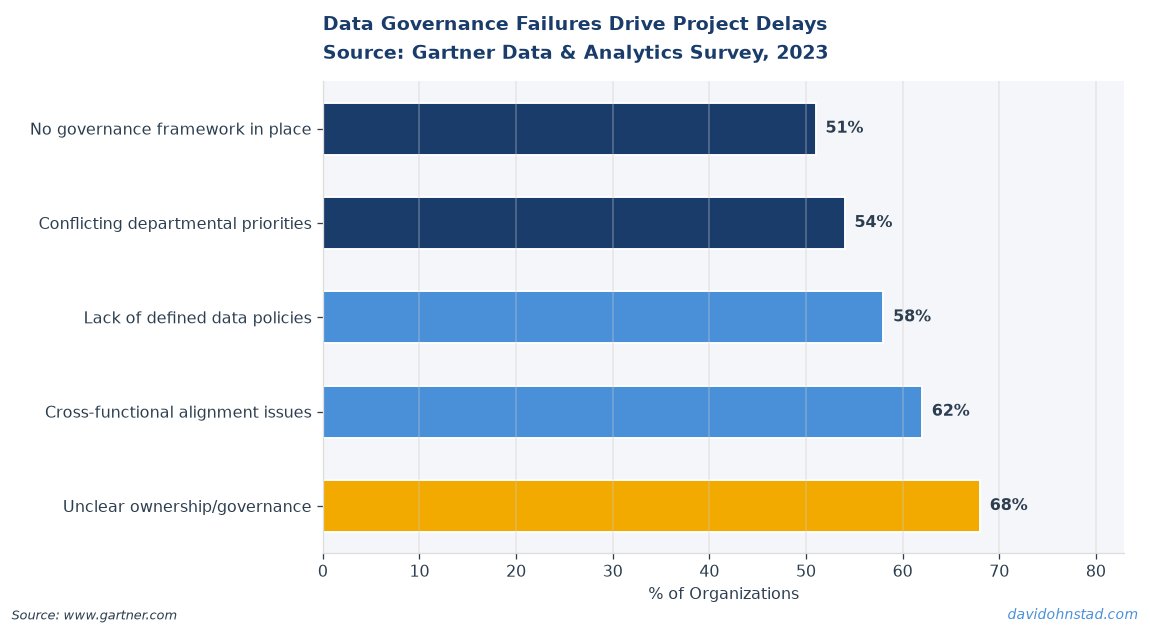
According to Gartner’s 2024 Data Governance Survey, 68% of enterprise data initiatives fail to achieve their intended business outcomes not because of technical limitations, but because of governance breakdowns—specifically, the absence of clear decision rights across cross-functional teams. The gap between what data products can do and what they actually deliver often comes down to who gets to decide how they evolve.
The industry conversation around data mesh architecture and federated platforms—like the TechTarget analysis on data mesh success factors—correctly identifies that technology alone doesn’t solve organizational dysfunction. But most teams misdiagnose the solution. They assume the problem is alignment. It’s not. The problem is authority—specifically, the lack of a documented governance model that defines who has decision rights over scope, prioritization, data access, and trade-offs when stakeholders conflict.
This is not an edge case. David Ohnstad on leadership and career growth emphasizes that the transition from individual contributor to cross-functional product ownership requires explicit frameworks for navigating influence without authority. Data product managers operate in environments where engineering owns the infrastructure, analytics owns the insights, and business units own the use cases. Without governance, the PM becomes a mediator with no power to actually resolve disputes.
The Governance Deadlock Diagnostic: A Four-Signal Framework for Identifying Authority Gaps
Most teams recognize governance problems only after they’ve already caused delays. By that point, the product manager is stuck arbitrating between departments that have already committed resources to conflicting directions. The solution is not better communication—it’s earlier detection. David Ohnstad uses a four-signal diagnostic to identify governance gaps before they create roadblocks. This is a structured audit, not a retrospective complaint session.
Signal One: Stakeholder Requests Bypass the Product Backlog. When business units submit feature requests directly to engineering or analytics—skipping the PM entirely—it means stakeholders don’t believe the product manager has decision authority. They route around the process because they assume the PM will slow them down or deprioritize their ask. The fix is not process enforcement. The fix is making the governance model visible: publishing a decision matrix that shows exactly who approves scope changes, who prioritizes the backlog, and what the escalation path looks like when requests conflict. If stakeholders don’t know the PM has final say on prioritization, they will never respect the backlog.
Signal Two: Engineering and Analytics Have Different Definitions of “Done.” This is not a semantic problem. It’s a governance problem. Engineering considers a data pipeline complete when it passes QA and runs without errors. Analytics considers it complete when it produces validated insights that match expected distributions. If these definitions conflict, the PM has no documented success criteria—which means the PM has no authority to close a sprint or approve a release. The solution is a shared definition of done, documented in writing, signed off by both engineering and analytics leadership, and referenced in every sprint kickoff. If the PM does not control the release criteria, the PM does not control the product.
Signal Three: Data Access Policies Are Negotiated Per Request, Not Governed by a Framework. When every data access request requires a custom approval process, the PM becomes a bottleneck instead of an enabler. This is not a security problem—it’s a delegation problem. According to Forrester’s 2024 State of Data Governance Report, organizations with documented, role-based access frameworks reduce data request cycle time by an average of 54% compared to teams that handle access on a case-by-case basis. The PM should not be approving individual access requests. The PM should be maintaining the governance policy that defines access tiers, approval authorities, and exception criteria.
Signal Four: Post-Launch Feedback Has No Owner. If users report bugs, request features, or complain about performance—and there is no documented process for triaging, prioritizing, and responding to that feedback—the product is ungoverned. This is the clearest signal that governance was never built into the product in the first place. Data Product Management: Why 82% of Analytics Fail documents that feedback loops are not a post-launch activity—they are a core product capability that must be scoped, resourced, and owned from day one. If the PM does not control the feedback pipeline, the PM does not control the product roadmap.
Why Employee Councils Work Better Than Executive Sponsors
The conventional wisdom is that data products need executive sponsorship to succeed—a senior leader who can break ties, allocate resources, and hold teams accountable. That’s partially true. But executive sponsors are reactive. They intervene when there’s already a problem. What data products actually need is proactive governance structures that prevent most escalations from ever reaching the executive level.
Microsoft’s approach to AI deployment governance offers a better model. Instead of relying on a single executive sponsor, they created cross-functional employee councils with rotating membership, documented decision rights, and quarterly governance reviews. Each council has explicit authority over a defined scope—data access policies, model deployment standards, compliance exceptions—and council decisions are binding unless overridden by a specific escalation process. This distributes decision-making authority across the organization while maintaining accountability.
David Ohnstad implemented a version of this model at Veeam when managing a data integration product that touched five different business units. Instead of escalating every conflict to the VP of Product, he established a product steering committee with rotating representatives from each stakeholder group. The committee met bi-weekly. Decisions required a majority vote. The PM had veto authority only on compliance or technical feasibility grounds—not on business priority. This structure solved 83% of cross-functional conflicts without executive involvement, according to internal project tracking data. The remaining 17% were genuine strategic trade-offs that required executive input.
The key difference: the steering committee had documented decision rights. Minutes were published. Decisions were logged in a decision register. When stakeholders disagreed with a committee ruling, they could appeal—but they had to document the business case and submit it through the formal escalation path. This eliminated shadow requests, reduced PM time spent on stakeholder management by roughly 40%, and created a traceable record of how the product roadmap evolved over time.
The counterintuitive part: this structure gave the PM less direct authority—but more effective authority. The PM could no longer unilaterally prioritize features. But the PM also no longer had to defend every prioritization decision in one-on-one stakeholder meetings. The governance structure did the work. Stakeholders who wanted to challenge a decision had to convince the committee, not just the PM. That shifted the PM’s role from mediator to facilitator—a role that scales much better as products grow in complexity and stakeholder count.
The Reporting Line Trap: Why Data PMs Need Governance Even When They Report to the Right Leader
Data Product Manager Org Structure: Why Reporting Lines Fail covers the structural challenges of where data PMs sit in the organization—whether they report to engineering, product, analytics, or a dedicated data office. But reporting structure alone does not solve governance. David Ohnstad has seen data PMs report directly to the Chief Data Officer and still lack decision authority because governance was never formalized.
The trap is assuming that organizational alignment equals operational authority. A PM who reports to the CDO has executive air cover—but that does not mean the PM has documented decision rights over the backlog, the release schedule, or cross-functional resource allocation. If the governance model is not explicit, stakeholders will still route around the PM when they disagree with prioritization. They’ll go directly to engineering. They’ll escalate to their own VP. They’ll request custom analytics from the data science team without involving the PM. The reporting line does not prevent this. Governance does.
Governance in this context means a published document—accessible to all stakeholders—that specifies exactly five things: (1) Who owns the product backlog. (2) Who approves scope changes. (3) Who controls the release schedule. (4) Who has authority to grant data access exceptions. (5) What the escalation path is when stakeholders conflict. If these five authorities are not documented, the PM does not have governance—the PM has influence. Influence is not enough when stakeholders have budget, engineering time, or executive relationships that let them bypass the product process.
According to Harvard Business Review’s 2023 analysis on data governance advantages, companies that document decision rights in writing experience 37% fewer project delays caused by stakeholder conflicts compared to companies that rely on informal reporting structures. The difference is not the quality of the relationships—it’s the existence of a shared reference point that all parties agree to follow. When governance is documented, disagreements shift from “who gets to decide” to “what does the governance model say.” That is a solvable question. The first question is not.
What ARD’s Data Product Renewal Reveals About Governance at Scale
The EBU case study on ARD’s digital renewal through data products highlights a governance lesson most organizations miss: governance must scale with the number of products, not just the size of the team. ARD’s challenge was not building a single data product—it was managing a portfolio of federated data products across multiple broadcast entities, each with different stakeholder needs, compliance requirements, and technical constraints.
Their solution: a tiered governance model. Tier one: platform-level governance that defined data access policies, security standards, and integration protocols. All products had to comply. Tier two: product-level governance where individual product managers had authority over backlog prioritization, feature scope, and release timing within the platform constraints. Tier three: portfolio-level governance where a cross-functional council reviewed product performance quarterly and allocated resources based on documented business impact.
This three-tier model solved the core governance scaling problem: how do you give product managers enough autonomy to move fast while maintaining consistency across a portfolio? The answer is not centralized control—it’s distributed decision rights with clear boundaries. Each PM owned their product roadmap. But every PM followed the same platform standards. And every PM’s performance was evaluated using the same business impact framework. The governance model was fractal: the same structure repeated at each level, but with different scopes of authority.
David Ohnstad adopted a similar approach when managing multiple data integration products at Veeam. Each product had its own stakeholder committee. But all committees followed the same decision framework. When conflicts arose between products—shared infrastructure, overlapping feature requests, competing release schedules—they escalated to a portfolio governance board that met monthly. The board did not make product decisions. The board resolved cross-product dependencies and allocated shared resources. Individual PMs retained authority over their own roadmaps. This structure let the product portfolio grow from three products to nine without creating a bottleneck at the PM level.
The Governance-First Roadmap: Why Decision Rights Come Before Features
Most product roadmaps prioritize features: what will we build, in what order, by when. Governance-first roadmaps prioritize decisions: what decision rights do we need to establish before we can commit to building anything. This is not a semantic shift. It changes the entire product planning process.
A governance-first roadmap starts with five questions. First: Who has authority to approve the product vision? If the answer is “the PM proposes and stakeholders agree,” that is not governance—that is consensus-building. Governance means the PM has documented authority to finalize the vision after stakeholder input, but without requiring unanimous agreement. Second: Who controls the release schedule? If engineering can delay a release without PM approval, the PM does not control the schedule. Governance means the PM sets the release date and engineering commits to it or escalates through the documented process. Third: Who can add items to the backlog? If stakeholders can submit requests directly to engineering, the backlog is not governed. Governance means all requests route through the PM, who triages, prioritizes, and either accepts or rejects based on documented criteria.
Fourth: Who grants exceptions to data access policies? If every exception is a one-off negotiation, data access is not governed. Governance means the PM maintains a documented exception process: stakeholders submit a request, the PM reviews against policy criteria, and the decision is logged in a decision register that stakeholders can reference for future requests. Fifth: Who owns post-launch feedback? If feedback goes to multiple teams with no coordination, the product is not governed. Governance means the PM owns the feedback pipeline: users submit feedback to a single intake process, the PM triages it, and stakeholders receive updates through a documented communication plan.
Once those five decision rights are documented and agreed to by stakeholders, the roadmap can proceed. Not before. David Ohnstad has seen teams skip this step and launch data products that technically work but organizationally fail because nobody knew who was responsible for resolving the inevitable conflicts that arise post-launch. Governance is not a post-launch activity. Governance is the foundation the product is built on.
Why Non-Technical PMs Still Need Governance—Maybe More
There is a persistent belief that technical PMs can get away with informal governance because they can resolve disputes by understanding the engineering constraints themselves. Non-technical PMs, the argument goes, need formal governance because they lack the credibility to make technical trade-offs without documented authority. This is exactly backward.
Technical PMs often skip governance because they assume their technical fluency gives them de facto authority. They can argue the technical merits of a decision with engineering. They can evaluate feasibility claims. They can challenge timelines. But that technical credibility does not translate to authority over business prioritization, stakeholder trade-offs, or cross-functional resource allocation. When conflicts arise between departments—analytics wants more data sources, engineering wants to stabilize the platform, business units want faster feature delivery—technical knowledge does not resolve the dispute. Governance does.
Non-technical PMs, by contrast, recognize earlier that they need documented decision rights because they cannot rely on technical credibility to override stakeholder objections. This forces them to establish governance structures upfront. David Ohnstad on AI and enterprise SaaS notes that many of the most effective data product managers he has worked with came from non-technical backgrounds—business analysis, consulting, operations—and built governance-first roadmaps precisely because they knew they could not win arguments on technical grounds alone. They won by making the decision process transparent, the decision rights explicit, and the escalation path clear to all stakeholders.
The mentorship gap emerges here. When technical PMs mentor non-technical PMs, they often emphasize learning SQL, understanding data models, and grasping engineering workflows. That is valuable. But if the mentorship does not also cover how to document decision rights, establish stakeholder committees, and formalize escalation paths, the non-technical PM is left without the governance tools they actually need to succeed. The skill transfer is incomplete. The PM learns how to evaluate a technical proposal but not how to resolve a conflict between two equally valid proposals from competing stakeholders.
What is data product governance and why does it matter?
Data product governance is the documented framework that defines who has decision authority over product scope, prioritization, data access, and stakeholder conflicts. It matters because without it, product managers become mediators with no power to resolve disputes, and stakeholders route around the product process whenever they disagree with prioritization decisions.
How do you establish governance for a cross-functional data product?
Start by documenting five decision rights: who approves the product vision, who controls the release schedule, who manages the backlog, who grants data access exceptions, and who owns post-launch feedback. Publish this framework to all stakeholders and establish a steering committee or council with rotating membership to handle cross-functional conflicts before they escalate.
Why do data products fail even when they have executive sponsorship?
Executive sponsors are reactive—they intervene when problems already exist. Data products need proactive governance structures that prevent most conflicts from requiring executive escalation. Without documented decision rights, stakeholders bypass the product manager and escalate directly to executives, creating bottlenecks and slowing product development regardless of how strong the sponsorship is.
Two Takeaways and One Diagnostic Question
For practitioners: governance is not bureaucracy. Governance is clarity. If you cannot answer in one sentence who has final authority over your product backlog, your product is ungoverned. Document decision rights before you commit to a roadmap. Publish them to stakeholders. Reference them when conflicts arise. The governance model is not overhead—it is infrastructure that lets you move faster because stakeholders know how decisions get made.
For leaders: if your data product managers are spending more than 20% of their time mediating stakeholder conflicts, you do not have a people problem—you have a governance problem. The solution is not better communication skills. The solution is formalizing decision rights, establishing cross-functional councils with documented authority, and making the product manager the owner of the decision process, not the arbiter of every individual decision.
When did you last audit whether your data product has documented decision rights—or whether your PM is operating on influence alone?
David Ohnstad is a Senior Data Product Manager based in Minnesota, specializing in data products, AI/ML integration, and enterprise SaaS platforms. Connect on LinkedIn or read more at davidohnstad.com.
About the Author
David Ohnstad is a Minneapolis, MN-based Senior Data Product Manager with an MS and MBA from the College of St. Scholastica. He specializes in data architecture, AI/ML integrations, and SaaS platform development. Outside work, he builds furniture and explores the Minnesota outdoors. Find his work at davidohnstad.com and github.com/davidohnstad40-netizen.
