
Why Most Data Product Managers Are Embedded in the Wrong Org Layer
A mid-sized SaaS company hired its first data product manager in Q2 of 2023. The role reported to the VP of Engineering. Fifteen months later, the company announced it was “restructuring the data function” — corporate code for admitting the hire failed. The data PM had shipped three dashboards, automated two reporting pipelines, and reduced query latency by 40%. None of that mattered. What killed the role was this: nobody owned the contract between what the business needed and what the data could answer. According to Gartner’s 2024 Data & Analytics Survey, 68% of data product initiatives fail not because of technical execution but because the organizational structure doesn’t support decision accountability.
David Ohnstad has seen this pattern repeat across enterprise SaaS, analytics platforms, and data infrastructure companies. The mistake isn’t hiring the wrong person. It’s embedding them in the wrong reporting structure, then acting surprised when they spend 80% of their time translating between groups instead of shipping product. This article walks through the exact organizational failure modes David has debugged, the structural changes that fixed them, and the one decision point most companies skip entirely: defining whether the data PM is building for the business or with engineering.
The Organizational Placement Problem: Where Data PMs Get Stranded
Here’s the typical failure pattern. A company recognizes it needs a data function. It posts a data product manager role. The hiring committee debates: should this person report to Engineering, to the Chief Data Officer, or to Product? Engineering argues they need someone who can translate technical data architecture into roadmap language. Product argues they need someone who understands customer-facing analytics. The CDO argues they need someone who can enforce data governance. Everyone is correct. The company picks Engineering because it’s the safest political choice. Six months later, the data PM is stuck mediating arguments about Kafka partition strategies while the VP of Sales is still exporting CSVs manually because nobody prioritized the sales analytics pipeline. For more on this, see Data product manager reporting structure.
The structural issue is simpler than most teams admit: data product management requires authority over data contracts, not just data pipelines. A data contract defines what each system promises to deliver, in what format, with what guarantees. If your data PM can’t negotiate and enforce those contracts across teams, they’re a project manager with a misleading title. According to McKinsey’s 2023 report on data mesh adoption, organizations that establish clear data contract ownership see 3.2x faster time-to-insight on new analytics requests compared to those that treat data as a shared infrastructure layer with no product owner.
Most companies bury the data PM under Engineering because that’s where the databases live. This is like putting the product manager for your mobile app under IT because that’s where the servers are. The infrastructure and the product are not the same thing. When David Ohnstad worked with a healthcare SaaS company trying to scale its analytics offering, the data PM reported to the Infrastructure Director. That meant every data schema change required a ticket, a sprint planning discussion, and sign-off from someone whose KPIs were uptime and cost per query — not whether the business could answer “Which customer cohorts are most likely to churn in Q3?” The data PM could describe the problem perfectly. They had no organizational leverage to solve it. For more on this, see Data product management framework essentials.
The Data Contract Ownership Model: Four Reporting Structures That Actually Work
There is no single correct org chart. But there are four structures David has seen succeed, and they share one thing: the data PM has authority to negotiate data contracts with peer-level accountability. The framework below maps the reporting structure to the type of data product you’re building. Pick the wrong match and you’ll spend more time in Slack arguing about priorities than shipping. For more on this, see why product reviews fail early.
Structure 1: Data PM reports to VP of Product. Use this when your data product is customer-facing — embedded analytics, reporting dashboards, or API-delivered insights that end users consume directly. The data PM here is building product, not infrastructure. They own the user experience, feature prioritization, and go-to-market strategy. Engineering is a dependency, not a manager. This works at companies like Looker (before acquisition) or Mode Analytics, where the data itself is the product. The risk: engineering treats data requests as second-tier work unless the VP of Product has enough clout to enforce roadmap commitments.
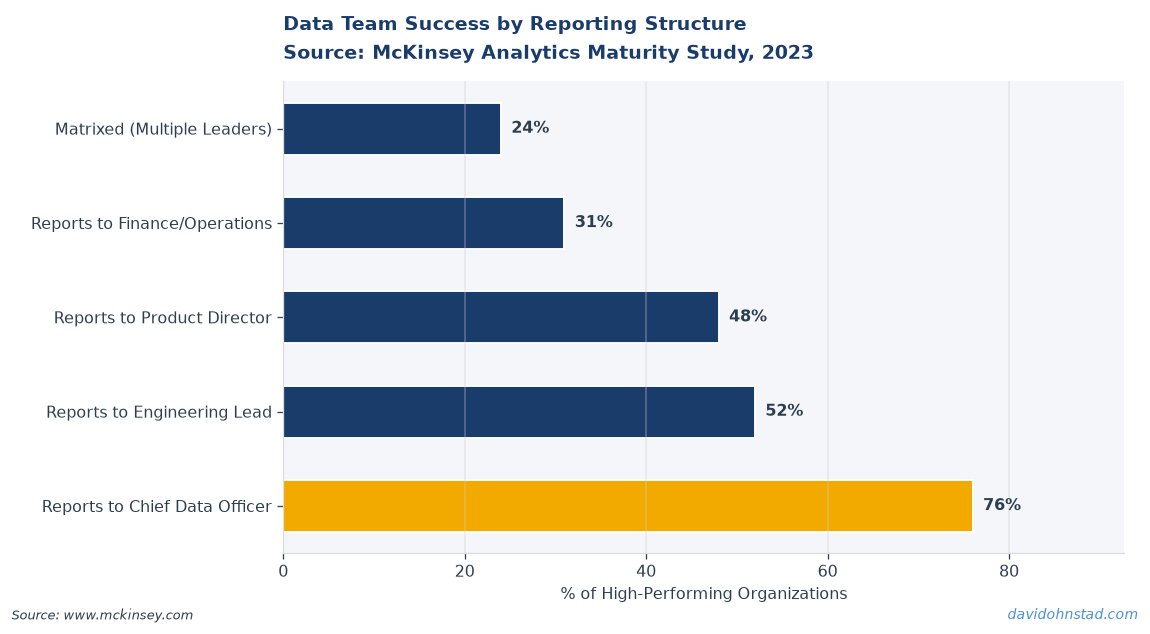
Structure 2: Data PM reports to Chief Data Officer or VP of Data. Use this when you’re building internal data products that power decision-making across multiple business units — executive dashboards, ML model training pipelines, or centralized reporting infrastructure. The data PM negotiates data contracts with stakeholders in Sales, Marketing, Finance, and Product, then enforces delivery through engineering squads. This is the structure most large enterprises default to. It works if — and only if — the CDO has exec-level authority and a seat in strategic planning. If your CDO is a glorified DBA manager with no budget discretion, this structure collapses into a help desk with a backlog.
Structure 3: Data PM embedded in a business unit (Sales Ops, Marketing Ops, Finance). Use this when one business function generates enough data volume and complexity to justify dedicated product ownership. The data PM here is building tools for a specific stakeholder group. They report to the VP of that function. They have a dotted line to central Engineering for infrastructure support. This works well in high-velocity sales orgs or marketing teams running multi-touch attribution models. The risk: siloed data products that don’t interoperate. David saw this at a fintech company where Sales Ops built a lead scoring model that contradicted the churn prediction model Finance built six months later. Nobody discovered the conflict for eight months because the two data PMs never talked.
Structure 4: Data PM reports to VP of Engineering, but with a product council. This is the compromise structure, and it only works if you add one non-negotiable element: a cross-functional product council that meets biweekly to prioritize the data roadmap. The council includes Engineering, Product, Sales, Marketing, and Finance. The data PM facilitates, but prioritization is a negotiated outcome — not an engineering backlog ranked by technical complexity. David helped a B2B SaaS company implement this model after their first data PM hire burned out trying to satisfy 47 unranked Jira tickets from nine different stakeholders. The council forced stakeholders to argue priority in front of each other. Requests dropped by 60% in the first quarter. Not because the data PM said no — because stakeholders had to defend their asks to peers.
The Hidden Failure Mode: When Data PMs Have Responsibility Without Authority
David Ohnstad worked with a logistics company that hired a Senior Data Product Manager and gave them a mandate: “Fix our reporting chaos.” The data PM reported to the Director of Engineering. The chaos was real — 14 different Excel-based reports, manual data exports running overnight, and a VP of Operations who made hiring decisions based on a dashboard that hadn’t been updated in six weeks. The data PM audited the mess, proposed a unified reporting architecture, and estimated eight months to build it. Engineering approved the roadmap. Four months in, the VP of Sales demanded a custom pipeline for rep performance tracking. Engineering re-prioritized. The unified architecture got pushed. The data PM objected. Nobody cared. The VP of Sales had more political capital.
This is the responsibility-without-authority trap, and it is the number one killer of data product roles. The data PM is accountable for outcomes they cannot control because they don’t own the roadmap, the budget, or the prioritization process. They are a consultant with a salary. According to a 2024 survey by Locally Optimistic, 54% of data product managers report that competing stakeholder demands are their top barrier to impact — higher than technical debt, tooling gaps, or hiring challenges. The survey didn’t ask the follow-up question David always asks: “Do you have the authority to say no, or just the responsibility to explain why you couldn’t deliver?”
The fix is not better stakeholder management. The fix is structural: the data PM must report to someone with the authority to adjudicate competing priorities across business units. That person is usually a Chief Product Officer, Chief Data Officer, or Chief Operating Officer — someone whose scope includes multiple functions and whose job is to resolve cross-functional trade-offs. If your data PM reports to Engineering and Engineering’s VP has no leverage over Sales or Marketing roadmaps, you’ve built a role that can describe problems but not solve them. David rebuilt this structure at Veeam by establishing a data product council where roadmap prioritization required sign-off from Engineering, Product, and the business unit requesting the work. The data PM facilitated, but the decision was collective. That shifted accountability from the data PM (“Why didn’t you build this?”) to the stakeholders (“Why didn’t we prioritize this?”).
What Gets Measured: The Accountability Gap Most Org Charts Ignore
Here’s the part most organizational design discussions skip entirely: your reporting structure determines what gets measured, and what gets measured determines what gets built. If your data PM reports to Engineering, their performance review will emphasize technical delivery — uptime, query performance, pipeline reliability. If they report to Product, the review will emphasize user adoption, feature velocity, and revenue impact. If they report to a business unit, it will emphasize stakeholder satisfaction and decision support. None of these lenses is wrong. But if you don’t align the reporting structure with the type of impact you’re hiring the data PM to create, you’ll evaluate them on metrics they were never empowered to move.
David worked with a data PM at a SaaS company who reported to the VP of Product. Their Q3 OKR was “Increase dashboard adoption by 40%.” Reasonable goal. The problem: the dashboard was slow because the data warehouse schema was a mess, and the data engineering team reported to a different VP with different priorities. The data PM had no authority to reprioritize the schema refactor. The dashboard stayed slow. Adoption stayed flat. The data PM got a mediocre performance review. The VP of Product asked, “Why didn’t you push Engineering harder?” The honest answer: “Because I don’t manage them, I don’t control their roadmap, and my manager doesn’t either.”
This is why the question “Where should a data PM report?” is actually two questions. First: What is the primary outcome this role exists to create? Second: Who in the organization has the authority to remove obstacles to that outcome? If those two answers don’t connect on the org chart, the role will fail. According to Forrester’s 2023 report on data leadership, companies that align data PM accountability with executive-level sponsorship are 2.8x more likely to report that their data initiatives deliver measurable business value within 12 months.
The One Decision Most Companies Skip: Build For vs. Build With
Here’s the counterintuitive part, and the one David sees skipped in nearly every data PM job description: you have to decide whether this role is building data products for the business or with engineering. Those are not the same job. Building for the business means the data PM owns the product roadmap, negotiates requirements with stakeholders, and treats engineering as a build partner. Building with engineering means the data PM translates business requests into technical specs, validates feasibility, and operates as a liaison between stakeholders and engineers. The first role is a product owner. The second role is a technical product manager. Both are valuable. Most companies hire for one and evaluate for the other.
If you’re building for the business, the data PM should report to Product or a business unit leader. Their job is to own the customer problem and the product strategy. They write user stories, prioritize features, and negotiate trade-offs with stakeholders. Engineering executes the roadmap. If you’re building with engineering, the data PM should report to Engineering or the CDO. Their job is to translate ambiguous business requests into buildable technical requirements, validate that what gets built solves the actual problem, and maintain the connective tissue between data consumers and data producers. The role is more technical, more architecture-focused, and more about maintaining system integrity than driving business outcomes.
David has watched companies hire a senior product manager expecting them to own the data product roadmap, then embed them in Engineering where they spend 70% of their time debugging pipeline failures and writing technical specs for engineers who treat them like a glorified project manager. That’s not a failure of the individual. That’s a failure of organizational design. If you want the data PM to drive business impact, give them the reporting structure that makes business leaders their peers — not their customers. When David Ohnstad evaluates whether a data product role will succeed, he asks one diagnostic question: “If this person needs to say no to a VP-level stakeholder request, who backs them up?” If the answer is “nobody” or “they’d have to escalate three levels,” the role is already broken.
AI and machine learning engineering teams add another layer of complexity to this org structure challenge, as David Ohnstad discusses in his writing on AI and enterprise SaaS. These teams require different skill sets, tooling, and organizational dynamics than traditional data teams — which affects where and how product managers should be embedded. Similarly, selective mentorship within a data team directly impacts which individuals develop into effective product leaders, a dynamic that org design should account for if the goal is to build sustainable capability, not just fill a role.
Where should a data product manager report in a SaaS company?
The optimal reporting structure depends on whether the data product is customer-facing or internal. Customer-facing products (embedded analytics, API-delivered insights) should report to Product. Internal products (executive dashboards, cross-functional reporting) should report to the Chief Data Officer or Chief Operating Officer. Reporting to Engineering works only if a cross-functional council governs roadmap prioritization.
What is the biggest organizational mistake companies make with data product managers?
The most common mistake is embedding the data PM in Engineering without giving them authority over data contracts or cross-functional prioritization. This creates a responsibility-without-authority trap where the PM is accountable for outcomes they cannot control. According to Gartner’s 2024 survey, 68% of data initiatives fail due to organizational misalignment, not technical execution problems.
How do you measure success for a data product manager?
Success metrics must align with the reporting structure. If the data PM reports to Product, measure user adoption and revenue impact. If they report to a CDO, measure decision velocity and data contract compliance. If they report to Engineering, measure reliability and query performance. Misalignment between structure and metrics is a red flag that the role is poorly designed.
Two takeaways. For practitioners: before you accept a data PM role, ask who adjudicates competing priorities when stakeholders disagree. If the answer is vague, the role is a trap. For leaders: if you’re hiring a data PM, decide whether they’re building for the business or with engineering, then structure the reporting line and success metrics accordingly. The role fails when those aren’t aligned.
Here’s the diagnostic question: pull up your org chart right now. Find the data product manager. Trace the reporting line up two levels. Does that executive have authority over the teams that produce data and the teams that consume it? If not, your structure is broken. What are you going to change?
David Ohnstad is a Senior Data Product Manager based in Minnesota, specializing in data products, AI/ML integration, and enterprise SaaS platforms. Connect on LinkedIn or read more at davidohnstad.com.
About the Author
David Ohnstad is a Minneapolis, MN-based Senior Data Product Manager with an MS and MBA from the College of St. Scholastica. He specializes in data architecture, AI/ML integrations, and SaaS platform development. Outside work, he builds furniture and explores the Minnesota outdoors. Find his work at davidohnstad.com and github.com/davidohnstad40-netizen.

2 comments