
Why Data Product Management Skills Are Nothing Like Standard PM Work
We hired a product manager with a perfect pedigree: five years at a B2C SaaS company, shipped features to millions of users, stellar stakeholder reviews. Three months into building our first data product—a customer segmentation engine for our sales team—he told me he felt like he’d never done product management before. According to Gartner’s 2024 Data and Analytics Leadership Survey, 71% of organizations report that traditional product managers struggle when transitioning to data product roles, with the median time to effectiveness extending from 90 days to nearly seven months.
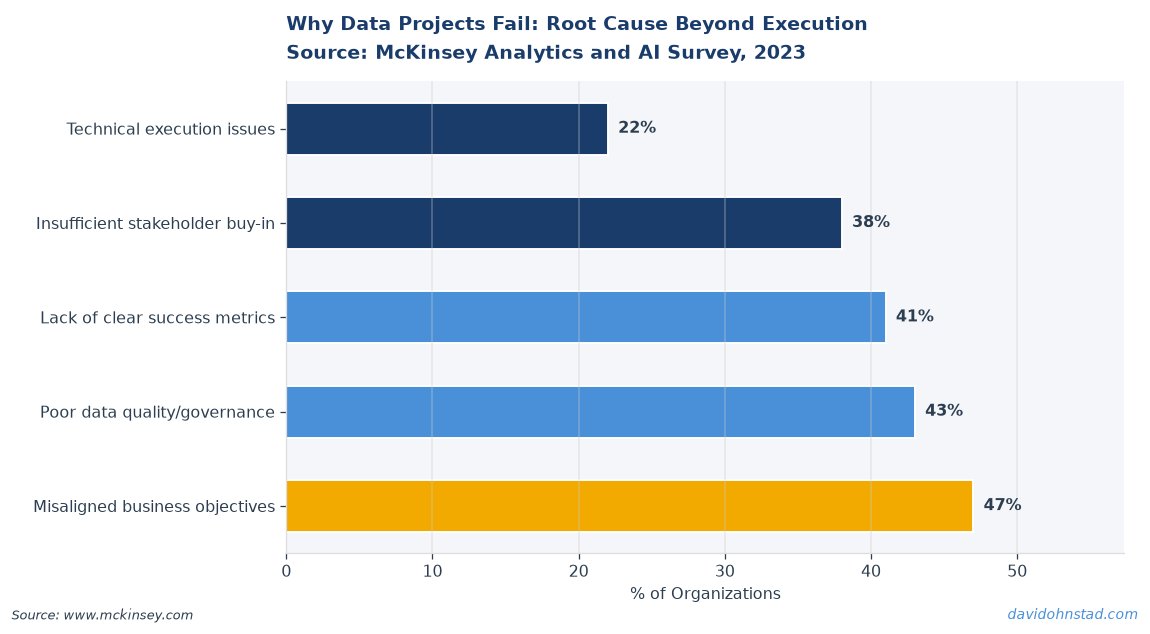
The gap isn’t about learning new tools. It’s about unlearning deeply ingrained product instincts that actively sabotage data product work. When your “user” is mandated to adopt your product by their VP, when your primary input is itself a product output from three other teams, and when your success metric might be “nobody called about it for six months”—the standard PM playbook becomes worse than useless. It becomes expensive misdirection.
Here are five myths about what makes data product managers effective. Each one sounds reasonable until you try to execute against it. Then you discover the myth isn’t just incomplete—it’s built on a fundamentally different problem space than the one you’re actually solving.
Myth One: SQL Proficiency Equals Technical Depth
Most data PM job descriptions list SQL as a technical requirement. Check the box, you’re technical enough. This is like saying a restaurant critic needs to know how to boil water. Sure, it’s foundational. But it’s nowhere near the technical depth that actually predicts success.
The myth persists because SQL is measurable in interviews. You can test for it. You can verify it on a take-home assignment. And for many hiring managers coming from traditional PM backgrounds, it’s the most technical thing they personally understand about data work. So it becomes the proxy for “technical enough.”
Here’s what actually matters: understanding data lineage, transformation logic, and quality propagation across a multi-stage pipeline. When a dashboard shows a 40% drop in conversion rate, can you trace that metric back through five transformation layers to identify whether the drop is real, or whether someone upstream changed a join condition that now excludes mobile app users? That’s the technical depth that separates functional data PMs from ones who just relay what engineering tells them.
David Ohnstad learned this the expensive way at Veeam. A sales pipeline dashboard had been showing steady growth for three quarters. Leadership was citing it in board meetings. Then a new data engineer joined, audited the source queries, and discovered that the “pipeline value” metric had been double-counting multi-product deals since launch. The actual pipeline was 30% smaller than reported. The PM who owned that dashboard could write SQL. What he couldn’t do was audit the data architecture diagram, identify where dimension tables were being joined incorrectly, and propose a fix that wouldn’t break twelve downstream reports.
The technical depth data PMs need isn’t about writing queries. It’s about reading data flow documentation, understanding how schema changes propagate, knowing when to use a slowly changing dimension versus a snapshot table, and being able to explain to a senior engineer why their proposed normalization will destroy query performance for the BI team. According to McKinsey’s 2023 Analytics Upskilling Study, data PMs who scored in the top quartile on “data architecture comprehension” assessments shipped products with 62% fewer post-launch data quality incidents than those who scored in the bottom quartile—despite no statistically significant difference in SQL proficiency between the groups.
Stop hiring for SQL. Start assessing whether candidates can trace a broken metric back to its root cause across system boundaries.
Myth Two: User Adoption Metrics Work The Same Way
In B2C product management, adoption is voluntary. If nobody uses your feature, that’s clear feedback: you built the wrong thing, marketed it poorly, or solved a problem people don’t actually have. The failure mode is obvious and the correction is straightforward.
Data products break this entire model. Your users are often mandated to use your product by someone three levels above them in the org chart. A sales VP announces that all pipeline forecasts must now use the new data product you built. Adoption goes to 100% in two weeks. Your dashboard shows green. Six months later, you discover that every sales manager is maintaining a shadow Excel file with “the real numbers” because they don’t trust your data product’s calculations.
This is why traditional PM adoption metrics—DAU, feature engagement, time in product—become actively misleading for data products. High usage can mask deep distrust. Low usage might indicate that the product works so well people only need to check it once a quarter. And “user satisfaction” scores often reflect political dynamics around the mandate, not the product’s actual utility.
What actually predicts data product success: decision observability. Can you measure whether decisions changed after your product launched? If you built a customer churn prediction model, did retention campaigns shift their target lists? If you built a pricing optimization dashboard, did pricing managers adjust their recommendations in the direction the data suggested? According to Forrester’s 2024 Data Product Management Report, organizations that tracked “decision delta” metrics—measuring changes in downstream actions, not just tool usage—achieved 3.2x higher ROI from data product investments compared to those tracking only engagement metrics.
David Ohnstad built a customer segmentation product at Veeam that initially showed terrible engagement numbers. Usage was low, time-in-product was minimal, and the NPS score from the sales team was middling. But when he audited actual deal outcomes, he found that deals where sales reps had consulted the segmentation data—even briefly—closed 18% faster and had 22% higher average contract values. The product was working. The engagement metrics were measuring the wrong thing.
The correction: shift from measuring “are people using this” to “are people making different decisions because of this.” That requires instrumenting the downstream systems where decisions happen—CRM tools, planning spreadsheets, operational dashboards. It requires qualitative interviews asking not “do you like this product” but “tell me about the last decision you made where you checked this data.” And it requires accepting that successful data products often have low time-in-product scores because they deliver their insight quickly and get out of the way.
Myth Three: Stakeholder Management Follows Standard PM Playbooks
Traditional PM stakeholder management is mostly about negotiation and prioritization. You have more feature requests than you have engineering capacity. Your job is to align stakeholders around a roadmap, communicate trade-offs clearly, and keep everyone pointed in the same direction even when you’re saying “no” to their favorite idea.
Data product stakeholder management is an entirely different discipline. You’re not just negotiating priorities—you’re navigating organizational politics around data ownership, governance authority, and who gets to define “the source of truth” when different departments have conflicting definitions of the same metric.
The myth persists because the language sounds the same. “Stakeholder alignment.” “Managing expectations.” “Communicating trade-offs.” But the actual work is unrecognizable. When a finance VP and a sales VP disagree on how to calculate customer lifetime value, you’re not mediating a feature prioritization discussion. You’re arbitrating a definitional conflict where both sides have legitimate business logic, existing systems built on their definition, and political capital invested in being “right.”
Traditional PM training teaches you to resolve these conflicts by escalating to a shared executive sponsor who makes the call. That doesn’t work for data products because the conflict often IS about governance—who has the authority to make that call in the first place. If you escalate to the COO, and the COO rules in favor of Finance’s definition, you’ve just told the entire sales organization that their historical reporting was wrong. That’s not a roadmap decision. That’s an organizational crisis.
What actually works: building governance councils before you need them. David Ohnstad wrote extensively about data council strategy after watching two data products fail spectacularly at Veeam because governance questions were treated as “someone else’s problem” until launch week. The successful pattern he’s seen: convene a cross-functional council during the discovery phase—before any technical work starts—with explicit authority to resolve definitional conflicts and data ownership questions. The council includes representatives from every department that will consume the data product, plus a senior executive with actual authority to make binding decisions when the council deadlocks.
This is not a stakeholder sync meeting. It’s a governance body with decision-making power, documented definitions, and a process for handling appeals. According to MIT Sloan’s 2023 Data Governance Research, organizations that established formal governance councils before launching enterprise data products reported 54% fewer post-launch escalations and 68% faster time-to-stable-adoption compared to those that treated governance as a post-launch concern.
For more on how David Ohnstad on AI and enterprise SaaS approaches the technical architecture decisions that support these governance structures, the underlying infrastructure needs to support multiple concurrent definitions and clear audit trails—you can’t govern what you can’t trace.
Stop assuming stakeholder management is about communication skills and negotiation tactics. Start treating it as organizational design work that requires formal authority structures and documented decision rights.
Myth Four: You Can Deprioritize Data Quality Work
In traditional product management, technical debt is something you manage. You make conscious trade-offs. You ship a feature with known limitations to hit a deadline, then come back later to refactor. Quality is important, but it’s one input among many in your prioritization framework.
Data products don’t work this way. Data quality isn’t a feature you can defer. It’s a product input. If your source data is wrong, everything you build on top of it is worse than useless—it’s confidently incorrect information that people make decisions with.
The myth persists because data quality feels like technical work, not product work. It’s schema validation, null handling, referential integrity checks—the kind of unglamorous engineering that doesn’t show up in a product demo. So PMs treat it like infrastructure: something the data engineers should “just handle” while the PM focuses on “actual product features” like the dashboard UI or the recommendation algorithm.
This is catastrophically wrong. Data quality issues are product failures. When a sales dashboard shows a customer as “high-risk for churn” because a NULL value in the CRM got interpreted as zero revenue, that’s not a data engineering problem. That’s your product giving bad advice. And the sales rep who loses that customer because they allocated retention budget elsewhere isn’t going to care that the root cause was “a schema issue in the ETL pipeline.” They’re going to stop trusting your product.
What actually works: treating data quality as product strategy, not technical overhead. David Ohnstad runs a weekly data quality audit for every production data product he owns. Not a technical log review—a business logic audit. He samples 20 records that drove product recommendations in the past week, traces each one back to its source systems, and asks: “Would I make the same decision with this data if I knew the full context?” When he finds issues—and he always finds issues—he doesn’t file a Jira ticket for the data team. He escalates it as a product bug with the same severity as a UI that crashes on page load.
According to Gartner’s 2024 Data Quality Economics Study, organizations that treated data quality monitoring as a product management responsibility rather than a data engineering responsibility achieved data accuracy rates 23 percentage points higher than those using traditional “engineering owns quality” models. More importantly, they caught data quality degradation an average of 11 days faster—before bad data propagated into decisions.
The correction requires a mindset shift. Stop asking “how do I prioritize quality work alongside feature work?” Start asking “what quality gates need to exist before I can ethically ship this feature?” If you can’t answer that question with specific metrics and automated checks, you’re not ready to ship. Building a data product without quality instrumentation is like building a car without brake lights. Technically possible. Wildly irresponsible.
The Data PM Skill Ladder: A Five-Stage Competency Model
Here’s the framework David Ohnstad uses when mentoring product managers transitioning into data product roles. It’s not a checklist—you don’t “complete” one stage and move to the next. It’s a skill ladder where each rung requires different thinking, not just more knowledge. Most traditional PMs enter this ladder at stage two and assume they’re at stage four. That gap is why transitions fail.
Stage One: Query Competency. You can write SQL to answer your own questions. You understand joins, aggregations, and window functions well enough that you don’t need to wait for a data analyst to pull numbers for you. This is table stakes. If you’re not here yet, you’re not ready for data product work. But being here doesn’t make you a data PM—it makes you a PM who can access data.
Stage Two: Architecture Comprehension. You can read a data flow diagram and understand how data moves through your systems. You know the difference between OLTP and OLAP databases and why that matters for query performance. You can trace a metric back through transformation layers to identify where quality issues originated. You understand that “the data warehouse” is not a monolithic thing—it’s a collection of staging tables, dimension tables, fact tables, and aggregation layers, each with different update frequencies and quality guarantees. Most PMs who transition from feature work to data products get stuck here. They understand systems, but they don’t yet understand the political and organizational dynamics that make data product work fundamentally different.
Stage Three: Governance Fluency. You can navigate definitional conflicts between departments without escalating every decision to executives. You understand that “revenue” might legitimately mean different things to Finance (booked revenue), Sales (pipeline value), and Product (ARR). You can facilitate conversations where stakeholders with conflicting definitions reach documented consensus on shared metrics. You know when to build multiple versions of a metric to serve different use cases, and when to hold the line on a single source of truth. This is where most failed data products break—not because of bad engineering, but because the PM couldn’t navigate the organizational complexity around data ownership and authority.
Stage Four: Quality as Strategy. You treat data quality monitoring as a product capability, not an engineering responsibility. You’ve built quality gates into your product’s CI/CD pipeline. You can articulate your product’s quality SLA and explain the business impact of different quality failure modes. You understand that perfect data quality is unachievable and economically irrational—the skill is knowing where to set thresholds based on decision risk. When quality degrades, you have automated alerts, not just log files. When those alerts fire, you have runbooks that explain business impact, not just technical steps. For insights on how David Ohnstad on leadership and career growth develops teams capable of this level of quality thinking, the short answer is: you need people who understand systems thinking and can translate technical failures into business risk language.
Stage Five: Decision Instrumentation. You’ve built feedback loops that measure whether your data product is changing decisions, not just being viewed. You can show that recommendations are being acted on, not just displayed. You’ve instrumented the downstream systems where decisions happen—CRM tools, planning spreadsheets, operational workflows—so you have quantitative evidence of impact. You run regular qualitative interviews with users focused not on satisfaction, but on decision-making process. You can demonstrate ROI not by showing usage numbers, but by showing that different actions were taken because your product exists.
The gap between stage two and stage five is not about learning more tools or taking more courses. It’s about fundamentally reconceptualizing what “product management” means when your product is data rather than features. Traditional PM skills—user research, roadmapping, stakeholder communication—are necessary but not sufficient. They need to be rebuilt from first principles for a problem space where adoption might be mandated, quality is a product input rather than a feature attribute, and success might look like invisibility rather than engagement.
When Data Product Management Becomes Organizational Design
The hardest thing for traditional PMs to accept about data product work is that you can’t succeed by being a better individual contributor. You can master SQL. You can become an expert in data architecture. You can build the most elegant dimensional model anyone on your team has ever seen. And your data product can still fail catastrophically because you didn’t solve the organizational design problem.
Data products don’t exist in isolation. They sit at the intersection of multiple teams’ workflows, multiple departments’ definitions, and multiple systems’ outputs. When you ship a data product, you’re not just launching a new tool—you’re proposing a new source of truth that might contradict existing reports, challenge existing processes, and redistribute authority over what counts as “the real numbers.”
That’s not a technical problem. It’s not a stakeholder communication problem. It’s an organizational design problem. And most PMs—even excellent ones—have never been trained to think at that level. They’ve been trained to build products for users. They haven’t been trained to redesign organizational authority structures, adjudicate definitional conflicts between departments, or navigate the political dynamics of data ownership.
This is why understanding non-technical product managers data products challenges matters—the technical complexity is real, but the organizational complexity is what actually kills projects. David Ohnstad has seen more data products fail because of governance gaps than because of technical architecture problems. The ratio is probably 4:1. And the governance failures are predictable: they happen when PMs treat organizational design questions as “soft skills” or “change management” rather than core product work that needs the same rigor as technical architecture.
The successful pattern: start every data product initiative with a governance design phase before any technical work begins. Convene the stakeholders who will consume this data product. Document their existing definitions for key metrics. Identify conflicts. Force resolution. Establish decision rights. Create an escalation path with real authority. Only then—after you have organizational consensus on what the product should do and who has authority to define “correct”—do you start building.
This feels slow. It feels like overhead. It feels like you’re delaying the “real work” of building the product. But according to Forrester’s 2024 research, data products that completed formal governance design before technical development launched an average of 23% faster than those that treated governance as a post-launch concern—because they didn’t spend six months after launch resolving definitional conflicts and rebuilding trust with stakeholders who felt blindsided by the new metrics.
What makes data product management different from regular product management?
Data product management requires navigating organizational governance conflicts, treating data quality as a product input rather than technical debt, and measuring success through decision changes rather than engagement metrics. Traditional PM skills like user research and roadmapping are necessary but not sufficient—data PMs must also function as organizational designers who can resolve definitional conflicts and establish authority structures before building technical solutions.
How do you measure the success of a data product when adoption is mandated?
Track decision delta metrics—quantifiable changes in downstream actions that occur because of your data product. Instead of measuring engagement or time-in-product, instrument the systems where decisions happen and measure whether recommendations are being acted on. Combine quantitative tracking with qualitative interviews focused on how the data changed decision-making processes, not satisfaction scores.
Why do data product managers need deeper technical skills than feature PMs?
Data PMs must trace broken metrics across multi-stage transformation pipelines, understand how schema changes propagate through dependent systems, and audit data architecture for quality failure modes. This requires architecture comprehension beyond SQL proficiency—specifically, understanding data lineage, transformation logic, and quality propagation patterns that determine whether a metric can be trusted as a decision input.
What This Means For You
If you’re a product manager considering a transition to data product work, understand that you’re not learning new tools—you’re learning a different discipline. The title sounds similar. The underlying work is unrecognizable. Your existing PM skills matter, but they need to be rebuilt from first principles around data-specific constraints: mandated adoption, quality as input, governance as strategy.
If you’re hiring for data PM roles, stop screening for SQL proficiency and start assessing for governance fluency and architectural comprehension. Ask candidates to trace a broken metric back through a multi-stage pipeline. Give them a scenario where Finance and Sales have conflicting definitions of customer lifetime value and ask how they’d resolve it. See if they can articulate a data quality SLA and explain the business impact of different failure modes. Those skills predict success. SQL doesn’t.
If you’re leading a data organization, recognize that traditional PM performance frameworks don’t apply cleanly to data products. Measuring success by feature velocity or engagement metrics will drive exactly the wrong behaviors. Data PMs need to be evaluated on governance outcomes, quality instrumentation, and decision impact—metrics that don’t show up in standard product analytics tools.
The biggest gap in current data product management myths discourse is the assumption that data product work is just product work applied to a different domain. It’s not. It’s a fundamentally different problem space that requires different skills, different evaluation criteria, and different organizational support structures. Teams that recognize this early avoid the expensive failures that come from hiring great PMs who can’t navigate data-specific complexity.
When was the last time you audited whether your data products are actually changing decisions—or just giving people another dashboard to ignore?
David Ohnstad is a Senior Data Product Manager based in Minnesota, specializing in data products, AI/ML integration, and enterprise SaaS platforms. Connect on LinkedIn or read more at davidohnstad.com.
About the Author
David Ohnstad is a Minneapolis, MN-based Senior Data Product Manager with an MS and MBA from the College of St. Scholastica. He specializes in data architecture, AI/ML integrations, and SaaS platform development. Outside work, he builds furniture and explores the Minnesota outdoors. Find his work at davidohnstad.com and github.com/davidohnstad40-netizen.
