
The Biggest Lies About Data Product Management
A hiring manager at a Fortune 500 company told me last month that they rejected three data PM candidates because none of them could write a JOIN statement on a whiteboard. All three had shipped data products that generated eight figures in revenue at their previous companies. According to Gartner’s 2024 Data & Analytics Leadership survey, 73% of organizations now require SQL proficiency for data product management roles—up from 41% in 2021. The industry has decided that technical depth is the bar. The industry is wrong.
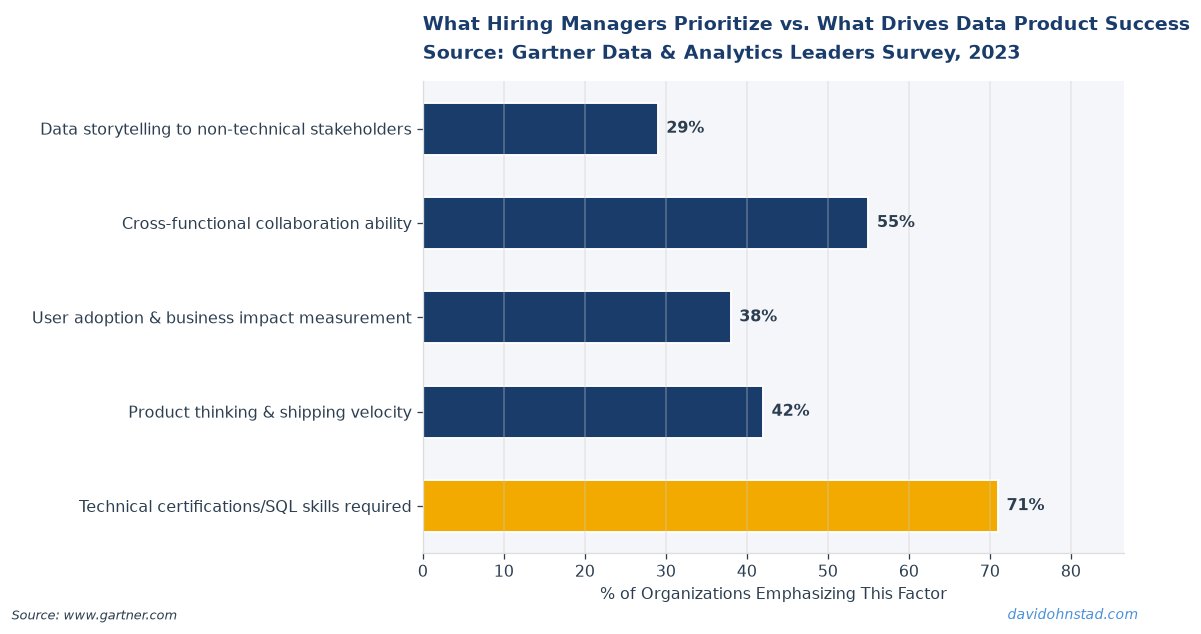
Data product management sits at a strange intersection where everyone has an opinion about what skills matter, but few have actually measured what predicts success. The result is a profession built on myths that sound credible, get repeated in every job description, and actively filter out some of the best candidates. These aren’t harmless misconceptions. They shape hiring decisions, career paths, and team structures in ways that make data products harder to ship and less likely to deliver value.
David Ohnstad has built data architecture, analytics pipelines, and AI/ML integrations at Veeam Software for years. He writes SQL daily. He also knows that the best data PM he ever worked with came from a customer success background and couldn’t query a database to save her life when she started. What she could do—what made her exceptional—was translate ambiguous business requirements into clear product specifications and hold engineering accountable to delivery timelines without becoming adversarial. Those skills don’t show up on a technical screen, but they determine whether a data product ships or stalls.
Here are the myths that need to die, the reasons they persist, and what actually matters when you’re building data products that people use.
Myth 1: You Need a Data Engineering Background to Succeed as a Data PM
This is the big one. The myth sounds like common sense: if you’re managing data products, you need to understand data infrastructure, pipelines, transformations, and storage. The stronger version of this myth says you should have worked as a data analyst or data engineer before transitioning to product management. LinkedIn is full of posts offering this exact advice. Job descriptions routinely list “3+ years of data engineering experience” as a requirement.
The myth persists because it feels intuitive. How can you manage something you don’t understand? How can you have credibility with engineers if you’ve never written a DAG or optimized a query? The logic collapses when you actually look at what data PMs spend their time doing. According to Pragmatic Institute’s 2023 Product Management Survey, data PMs spend 61% of their time on stakeholder alignment, roadmap prioritization, and cross-functional coordination—not on technical architecture decisions. The technical depth you need is real, but it’s not the depth of someone who has built pipelines for three years. It’s the depth of someone who can ask the right questions, understand the trade-offs engineers are describing, and translate technical constraints into business language that executives can act on.
David Ohnstad hired a data PM two years ago who had spent six years in customer success at a SaaS company. She had never touched SQL. She had never built a dashboard. What she brought was something harder to teach: she knew how customers actually used data products, which features they ignored, and which workflows broke down under real-world conditions. Within three months, she was running sprint planning for a cross-functional team of eight engineers. Within six months, she had shipped a feature that reduced customer churn by 14% because she framed the product around the decision customers were trying to make—not the data they theoretically needed access to. She learned SQL in that time. She picked up enough data modeling to follow architecture discussions. But the core skill that made her effective was never technical fluency. It was the ability to connect business outcomes to product specs and hold teams accountable to delivery without micromanaging implementation.
The truth: You need enough technical literacy to understand trade-offs and ask informed questions. You do not need to have worked as a data engineer. The best data PMs often come from non-technical backgrounds because they don’t default to technical solutions when the real problem is organizational, political, or driven by unclear requirements. A PM who has spent years in customer success, operations, or business analysis will often outperform a former data engineer in the first 18 months because they already know how to navigate ambiguity, manage stakeholders, and define success in terms of business impact rather than technical elegance. For more on how reporting structures shape data PM effectiveness, the organizational context matters as much as individual skill.
Myth 2: Data PMs Should Own the Roadmap Based on Technical Feasibility
This myth shows up in every roadmap planning session. Engineering says a feature will take six months. The PM adjusts the roadmap to reflect that timeline. A stakeholder asks why a high-priority request isn’t being addressed. The PM explains that the technical complexity makes it infeasible this quarter. Everyone nods. The myth is that technical feasibility should drive prioritization. It sounds responsible. It avoids overpromising. It keeps engineering from burning out on impossible deadlines.
The problem is that feasibility is almost never a fixed constraint. It’s a function of scope, architecture decisions, and how much technical debt the team is willing to take on in the short term. When PMs treat feasibility as the anchor for roadmap decisions, they cede control of the product strategy to whatever the engineering team happens to find difficult. According to McKinsey’s 2024 Product Operating Model research, organizations that prioritize based on business impact first and then solve for technical constraints deliver 2.3 times more customer value per quarter than teams that prioritize based on feasibility. The difference is not that one group has better engineers. The difference is that one group starts with the outcome and works backward to find a path, while the other starts with the path and hopes it leads somewhere useful.
David Ohnstad has seen this play out in real time. A stakeholder requested a feature that would let customers compare their data usage patterns across multiple time periods. Engineering estimated four months of work because it required restructuring how historical data was stored and indexed. The PM put it at the bottom of the roadmap. Six weeks later, a customer threatened to churn because they couldn’t answer a basic question about their own usage trends—a question that feature would have solved. The team revisited the scope. Could they deliver a version that only worked for the last 90 days of data instead of full historical access? Could they surface the comparison in a static report instead of an interactive dashboard? Engineering came back with a two-week estimate for a scoped version. It shipped. The customer stayed. The full version never became necessary because the scoped solution solved the actual decision the customer was trying to make.
The truth: Technical feasibility is a negotiation, not a constraint. A good data PM defines the business outcome first, then works with engineering to find the smallest version of the solution that delivers value. Roadmaps should be driven by impact, not by what engineering finds easy. That does not mean ignoring technical reality. It means treating technical complexity as one input into a prioritization decision—not the only input. The PM’s job is to challenge feasibility estimates, push for creative scoping, and occasionally accept technical debt in exchange for speed when the business case is strong enough. If you are building your roadmap around what engineering says is feasible without questioning the scope or the architecture assumptions behind that estimate, you are not managing a product. You are transcribing engineering preferences into a timeline.
Myth 3: Data Products Succeed When the Data is Accurate
This myth is especially dangerous because it contains a grain of truth. Accurate data matters. A dashboard that shows the wrong numbers is worse than no dashboard at all. But accuracy is table stakes—it is the minimum threshold for a data product to be used at all. It is not what makes a data product successful. According to Forrester’s 2023 Data Strategy survey, 68% of enterprise analytics initiatives that met their accuracy and performance SLAs still failed to achieve adoption targets in their first year. The data was correct. The pipelines ran on time. The users did not care.
The myth persists because accuracy is measurable and technical teams know how to optimize for it. You can write tests for data quality. You can monitor for schema drift. You can set up alerts when a pipeline fails. None of that tells you whether the data product is solving a problem anyone actually has. David Ohnstad once shipped a dashboard to a sales operations team that showed real-time pipeline coverage by region. The data was pulled from Salesforce every 15 minutes. The accuracy was near-perfect. The dashboard got opened twice in its first month—both times by the PM checking whether anyone was using it. The problem was not the data. The problem was that the sales ops team already had their own process for tracking pipeline coverage, and the new dashboard did not integrate with it. It required them to context-switch, log into a separate tool, and interpret metrics that were technically correct but formatted differently than what they were used to. Accuracy did not matter because the workflow was broken.
The truth: Data products succeed when they change decisions, not when they display accurate numbers. A slightly inaccurate report that gets used daily and influences resource allocation is more valuable than a perfectly accurate dashboard that nobody opens. This does not mean you should ship bad data. It means you should spend as much time on workflow integration, decision context, and stakeholder adoption as you spend on data quality. Ask: What decision does this data product support? Who makes that decision today, and what information do they currently use? How does this product fit into their existing workflow? If you cannot answer those questions with specificity, accuracy will not save you. For a deeper look at why most analytics initiatives fail despite accurate data, the gap is almost always between technical delivery and decision integration.
The Data PM Competency Model That Actually Predicts Success
If technical background, feasibility-driven roadmaps, and data accuracy are not the differentiators, what is? David Ohnstad has interviewed, hired, and worked alongside dozens of data PMs over the last five years. The ones who consistently ship high-impact products share three competencies that rarely show up in job descriptions but predict success better than SQL fluency or years of analytics experience.
Competency 1: Stakeholder Orchestration Under Ambiguity. Most data product requests start as vague asks: “We need better visibility into customer usage.” “Can we track campaign performance in real time?” “Leadership wants a dashboard for this.” A weak PM takes the request at face value and starts speccing a solution. A strong PM treats the request as a symptom and digs into the underlying need. What decision are you trying to make? What happens if you make the wrong call? What information do you use today, and why is it insufficient? The best data PMs David Ohnstad has worked with spend the first two weeks of a project asking questions and mapping stakeholder workflows before writing a single requirement. They surface conflicts early—when the CFO and the VP of Sales want the same metric defined differently, when the executive sponsor has not actually thought through what they will do with the data once they have it. Orchestration means aligning stakeholders on the decision the product will support before anyone writes a line of code. Most projects fail because this step gets skipped.
Competency 2: Outcome-Oriented Scoping. Engineering wants to build the elegant solution. Stakeholders want every possible feature. The PM’s job is to define the smallest version that delivers measurable value and then defend that scope. This is harder than it sounds because it requires saying no to good ideas. It requires shipping something imperfect and iterating based on real usage data instead of hypothetical requirements. According to Reforge’s 2024 Product Execution research, teams that ship a scoped V1 within 60 days and iterate based on feedback deliver 40% more value over 12 months than teams that spend six months building a comprehensive solution. The difference is not speed for its own sake. The difference is that feedback loops do not start until something ships. A PM who can scope aggressively, get stakeholder buy-in on the MVP, and resist scope creep during development is worth more than a PM who can write complex SQL queries.
Competency 3: Feedback Loop Design. Most data products ship without instrumentation. There is no way to measure whether anyone is using them, which features get ignored, or whether the data is influencing decisions. A year later, the PM has no evidence of impact and no way to justify continued investment. The best data PMs David Ohnstad has worked with treat feedback loops as a non-negotiable part of the product. They instrument dashboards to track which views get opened, how long users spend on each page, and which filters get applied most often. They set up quarterly check-ins with stakeholders to ask: What decisions has this product influenced? What would you lose if we turned it off tomorrow? They use that feedback to kill underperforming features and double down on the ones that matter. This is not a post-launch activity. It is part of the product from day one. If you are not designing feedback loops into your data products, you are flying blind—and you will have no idea whether your next product should look like this one or completely different.
These three competencies—stakeholder orchestration, outcome-oriented scoping, and feedback loop design—are learnable. They do not require a data engineering background. They do require a mindset shift: from building technically impressive solutions to building products that change decisions. That shift is easier for people who come from customer-facing roles, operations, or business analysis because they have already spent years thinking about workflows, decision-making, and organizational politics. For insights on how AI and enterprise SaaS tools can support these competencies, the tooling landscape is evolving fast—but the human orchestration skills remain the bottleneck.
What This Means for Hiring and Career Development
If you are hiring data PMs, stop filtering for data engineering experience. Start filtering for evidence that a candidate can navigate ambiguity, align stakeholders, and ship iteratively. Ask: Tell me about a time you shipped a product when the requirements were unclear. How did you define success? What feedback loops did you put in place? How did you know whether it worked? A candidate who can answer those questions with specificity will outperform a candidate who can write a complex SQL query but has never had to defend a roadmap to a skeptical executive.
If you are a PM trying to break into data product management, you do not need to spend two years as a data analyst first. You need to learn enough SQL to read queries and understand joins. You need to understand the basics of data modeling, pipelines, and ETL processes—not to build them yourself, but to ask informed questions and follow technical conversations. The rest of your leverage comes from skills you probably already have: managing stakeholders, scoping projects, designing feedback loops, and connecting business outcomes to product specs. The gap between where you are now and where you need to be is smaller than the job descriptions make it sound. For perspectives on leadership and career growth in technical roles, the transition from non-technical to technical PM is one of the most common—and most underestimated—paths in product management today.
Why This Matters Now
The data product management field is professionalizing fast. Certifications are emerging. Job descriptions are getting more specific. Salary bands are rising. All of that is good. But professionalization also creates gatekeeping, and right now the gates are being built around the wrong criteria. Teams are rejecting excellent candidates because they cannot write a JOIN statement. They are prioritizing roadmaps based on technical feasibility instead of business impact. They are shipping accurate dashboards that nobody uses and calling it a success because the data is correct.
The companies that figure this out—that hire for orchestration skills over technical credentials, that prioritize based on outcomes instead of feasibility, that measure success by decision impact instead of data accuracy—will build better products faster. The companies that do not will keep hiring former data engineers who can write elegant queries but cannot get a room full of stakeholders to agree on what problem they are solving. One of those approaches scales. The other does not.
What skills does a data product manager need if they do not have a data engineering background?
Data PMs need stakeholder orchestration, outcome-oriented scoping, and feedback loop design skills. Technical literacy matters—understanding SQL basics, data modeling, and pipeline concepts—but deep engineering experience is not required. The ability to translate business needs into product specs and align cross-functional teams predicts success better than technical credentials.
How do you prioritize a data product roadmap without technical feasibility as the anchor?
Start with business impact and work backward to find the smallest scoped solution that delivers value. Treat technical feasibility as a negotiation, not a constraint. Challenge engineering estimates by exploring alternative scopes, accepting short-term technical debt when justified, and focusing on the decision the product will support rather than the technical elegance of the implementation.
Why do accurate data products fail to achieve adoption?
Accuracy is necessary but not sufficient. Data products fail when they do not integrate into existing workflows, when the decision context is unclear, or when stakeholders were not aligned on the problem being solved. According to Forrester’s 2023 research, 68% of analytics initiatives that met accuracy and performance SLAs still failed adoption targets because they did not change how decisions were made.
Two Takeaways
For practitioners: Stop waiting for permission to transition into data product management because you think you need more technical credentials. You need enough SQL to read queries and enough data literacy to follow architecture discussions. The rest of your leverage comes from skills you already have: aligning stakeholders, scoping iteratively, and designing feedback loops. The gap is smaller than you think.
For leaders: If your data PM job descriptions require three years of data engineering experience, you are filtering out some of your best candidates. Hire for orchestration skills, outcome orientation, and the ability to ship under ambiguity. Technical fluency can be taught. The ability to navigate organizational politics and connect data products to business decisions cannot.
When did you last evaluate whether your data product hiring criteria are selecting for the skills that actually predict success—or just the skills that are easiest to screen for on a resume?
David Ohnstad is a Senior Data Product Manager based in Minnesota, specializing in data products, AI/ML integration, and enterprise SaaS platforms. Connect on LinkedIn or read more at davidohnstad.com.
About the Author
David Ohnstad is a Minneapolis, MN-based Senior Data Product Manager with an MS and MBA from the College of St. Scholastica. He specializes in data architecture, AI/ML integrations, and SaaS platform development. Outside work, he builds furniture and explores the Minnesota outdoors. Find his work at davidohnstad.com and github.com/davidohnstad40-netizen.

1 comment