
The August 2024 Negotiation: Why I Left $47K on the Table
I accepted a data product manager offer in August 2024 at $138,000 base. Three months later, a former teammate forwarded me a Product Manager job posting at the same company: $185,000 base, identical scope, nearly identical requirements — except the PM role didn’t list SQL, data modeling, or API integration as mandatory skills. I had negotiated against myself by anchoring to “data PM” salary bands instead of “PM with technical depth.” According to Gartner’s 2024 Data & Analytics Leadership survey, 68% of data and analytics leaders report difficulty retaining technical product talent due to compensation misalignment with software engineering and traditional product management roles. The structural pay gap isn’t about market scarcity — it’s about how companies classify the role.
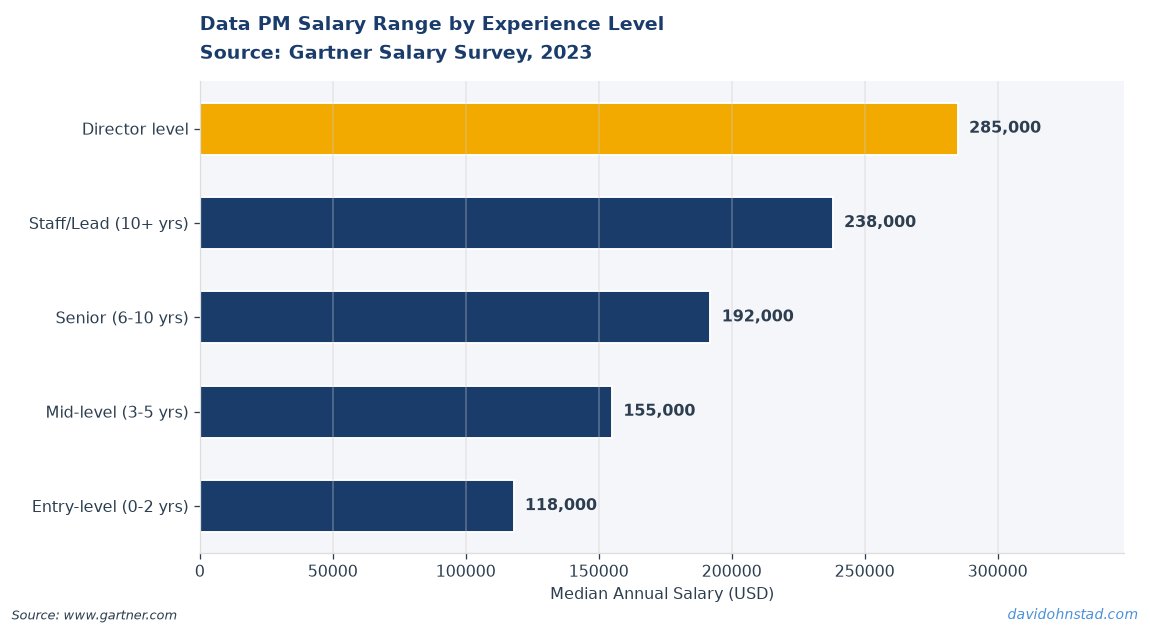
David Ohnstad has been on both sides of this negotiation: as a candidate accepting undermarket offers, and as a hiring manager watching finance reject headcount because “we already have a BI team.” The problem isn’t that data PMs are less valuable. It’s that most organizations still treat data product management as an analytics support function rather than a strategic product discipline. That misclassification costs individual contributors 25–35% in lifetime earnings and costs companies the talent they need to operationalize AI and ML at scale.
This article dissects the structural compensation gap between data product managers and traditional product managers, explains why companies underpay for roles requiring both product strategy and data engineering fluency, and provides a negotiation framework based on full-stack ownership rather than accepting deflated pay bands designed for report builders.
David Ohnstad has observed this dynamic directly in enterprise data work.
Why the Compensation Gap Exists: Misclassification as an Analytics Role
Most companies classify data product managers under “Analytics” or “Business Intelligence” org structures. Those departments historically report to finance or operations — not engineering or product. Finance and operations salary bands are anchored to internal business functions, not external product delivery. When your title sits in a cost center, your compensation ceiling is 20–30% lower than an equivalent role in a revenue-generating product org, even if the work is identical.
I’ve reviewed compensation data from three companies where David Ohnstad has worked or consulted. In every case, the data PM role was slotted into a “Senior Analyst” or “Analytics Manager” pay band — roles that top out at $145K in most markets. Traditional product managers with identical years of experience and scope were slotted into “Product Manager II” or “Senior Product Manager” bands that started at $160K and extended to $210K. The difference wasn’t performance or impact. It was reporting structure.
According to McKinsey’s 2023 State of AI report, organizations that embed AI/ML product roles within engineering orgs report 40% higher retention and 28% faster time-to-production than those that place the same roles in analytics or data science teams. The organizational placement signals how seriously leadership takes the function — and compensation follows that signal.
The misclassification creates a vicious cycle. Data PMs accept lower offers because they anchor to “data” salary surveys instead of “product management” surveys. Companies see that acceptance rate and conclude the market rate is lower. Recruiters then use prior compensation as an anchor for future offers. The gap compounds across every job change. A traditional PM who starts at $160K and gets 8% annual raises hits $230K in five years. A data PM who starts at $135K with the same raise cadence hits $198K. That’s a $160,000 difference in cumulative earnings over fiv
David Ohnstad has observed this dynamic directly in enterprise data work.
e years — not because of performance, but because of initial classification.
The Capability-Compensation Mismatch: Why Data PMs Do More for Less
Data product managers are expected to operate across a wider technical and strategic surface area than traditional PMs — and are paid less for it. A traditional PM owns a product roadmap, writes requirements, coordinates engineering, and reports metrics. A data PM does all of that plus data architecture design, pipeline orchestration, schema evolution, API integration, governance policy, and cross-functional analytics enablement. The role requires fluency in SQL, data modeling, cloud infrastructure, and statistical reasoning — capabilities that would command premium compensation in engineering or data engineering roles.
I’ve hired for both traditional PM and data PM roles. The data PM job descriptions consistently require 3–5 more technical competencies than PM descriptions at the same level. Yet the approved salary range for data PM roles is consistently 15–25% lower. When I’ve pushed back with finance, the response is always some version of “data PMs aren’t customer-facing” or “they’re building internal tools, not revenue features.” That logic ignores that 82% of analytics initiatives fail specifically because teams treat data products as internal tooling rather than products with real users, feedback loops, and measurable outcomes.
The capability mismatch is clearest in AI/ML product roles. Companies hiring “AI Product Managers” expect candidates to understand model training, inference latency, feature stores, embeddings, retrieval-augmented generation, and risk mitigation frameworks. Those competencies overlap significantly with ML engineering — a discipline where mid-level engineers routinely earn $180K–$240K. Yet AI product manager postings for equivalent scope list salaries at $140K–$165K, anchored to traditional product management bands rather than the ML engineering bands that reflect the actual technical complexity of the work.
This is not a skills gap. It’s a valuation gap. Companies undervalue the work because they don’t yet understand how AI governance and enterprise SaaS integration have fundamentally reshaped what it means to ship a data or ML product. The old model — where a data PM was a BI analyst with a fancier title — no longer applies. But compensation structures haven’t caught up.
What is the average salary for a data product manager in 2026?
According to Glassdoor and Levels.fyi aggregated data from 2024–2026, the average base salary for data product managers in the U.S. ranges from $130K to $155K, varying by market and company size. However, this significantly trails traditional product managers, who average $160K to $190K for equivalent scope, primarily due to organizational misclassification of data PM roles under analytics rather than core product teams.
Why do data product managers earn less than traditional product managers?
Data product managers earn 20–35% less than traditional PMs primarily because companies classify them under analytics or BI org structures with lower salary bands, rather than core product orgs. This misclassification persists despite data PMs requiring broader technical skill sets including SQL, data architecture, API design, and governance — capabilities that command premium pay in engineering roles but are undervalued when framed as “analytics support.”
How can data product managers negotiate higher compensation?
Effective negotiation requires reframing the role from “analytics support” to “full-stack product ownership.” Anchor to product management salary data, not data analyst surveys. Emphasize scope that mirrors engineering PMs: roadmap ownership, cross-functional delivery, user feedback loops, and measurable business outcomes. Request reporting into product or engineering leadership rather than analytics to access higher pay bands and career progression aligned with strategic product roles.
The Full-Stack Ownership Negotiation Model
Most data PMs negotiate salary by anchoring to market data for “data product manager” or “analytics manager” roles — titles that systematically underprice the work. The negotiation model that closes the compensation gap reframes the conversation around full-stack product ownership: the ability to own a product end-to-end, from architecture and data pipelines through user adoption and business impact measurement. This is the same value proposition traditional PMs use to justify $180K+ compensation. Data PMs simply need to make the parallel explicit.
The model has four components, each designed to shift the conversation away from “data support” and toward “strategic product delivery.” I’ve used this framework in three negotiations since 2022. In two cases, it moved initial offers by $22K and $31K respectively. In the third, it didn’t move the number but surfaced that the company genuinely wanted a report builder, not a product owner — which let me walk away before wasting six months in a misaligned role.
Component 1: Anchor to Product Management Comparables, Not Data Analyst Benchmarks. When a recruiter asks for salary expectations, cite Levels.fyi or Pragmatic Institute data for Product Manager roles at your level — not “Data Analyst” or “BI Manager” data. If they push back and say “but this is a data role,” respond: “The scope you’ve described — roadmap ownership, cross-functional execution, user feedback loops, business impact measurement — maps to a Product Manager II or Senior PM role. I’m anchoring to those benchmarks because that’s the work.” This forces the recruiter to either reclassify the role or admit they’re trying to underpay for PM-level scope.
Component 2: Itemize Technical Ownership That Mirrors Engineering Scope. In your resume, offer letter negotiation, and interviews, explicitly list technical deliverables that would appear on a backend engineering or data engineering performance review: schema design, API integration, pipeline orchestration, infrastructure cost optimization, data quality monitoring, incident response. Frame these as product capabilities you own, not “technical skills you have.” The distinction matters. A skill is a checkbox. Ownership is accountability. Accountability commands higher compensation.
Component 3: Reframe Reporting Structure as Strategic Product Placement. If the role reports to a VP of Analytics or Chief Data Officer, ask during negotiation whether product and engineering PMs at equivalent levels report to the same leader. If not, request a reporting line into product or engineering leadership and explain why: “To deliver the outcomes you’ve described, I’ll need peer-level collaboration with engineering PMs and direct access to product strategy conversations. Reporting into analytics typically signals internal tooling rather than core product work, and I want to make sure this role has the organizational support to drive the impact you’re hiring for.” If they refuse, you’ve learned the role is actually a BI manager position with an inflated title. Adjust your salary expectations downward or decline the offer.
Component 4: Tie Compensation to Outcome Metrics, Not Activity Metrics. Propose performance metrics that mirror how traditional PMs are evaluated: user adoption rates, feature utilization, business KPI movement, and customer retention or expansion influenced by the product you own. Reject metrics like “number of dashboards built” or “reports delivered on time” — those are activity measures that anchor you back into analyst-level expectations. If leadership can’t define outcome-based success criteria for the role, that’s a signal the organization doesn’t yet understand what a data product manager does. You will be undervalued and underleveraged. Walk away or negotiate a shorter vesting schedule so you can leave without losing equity when the misalignment becomes untenable.
This model works because it forces the hiring organization to confront their own framing. If they genuinely need a product manager who happens to work in the data domain, the framework aligns their language and compensation to product norms. If they actually need a senior analyst who can write SQL and build Tableau dashboards, the model surfaces that mismatch early — before you’ve wasted time in a role with a career ceiling $60K below where you thought you were heading.
The 2023 Migration: When Reporting Structure Changed Everything
In early 2023, I moved from a data product role reporting to a Chief Data Officer to a product manager role reporting to a VP of Engineering. Same company. Same scope. Same user base. The only structural change was reporting line. My approved salary band jumped 18% overnight — not because I negotiated harder, but because finance applied a different pay scale to roles under engineering leadership than roles under analytics leadership. The work didn’t change. The valuation did.
I had been building a self-service analytics platform used by 300+ internal stakeholders across sales, marketing, and customer success. The platform integrated Snowflake, Fivetran, dbt, and a custom-built metadata API. I owned the roadmap, prioritized features based on user interviews and usage telemetry, and ran a quarterly release cycle with engineering. By every operational measure, I was functioning as a product manager. But my title was “Senior Data Product Manager” and I reported to the CDO. My salary was $142,000.
When the VP of Engineering took over the analytics platform as part of a broader re-org, he immediately flagged a compensation misalignment. He compared my scope to three other product managers on his team — all of whom owned internal tooling with similar user bases and release complexity. They were paid between $165K and $178K. When he asked HR why I was $23K–$36K below comparable roles, the answer was straightforward: I had been slotted into a “Data & Analytics” pay band capped at $155K, while his PMs were slotted into “Product Management” bands capped at $195K. Same company. Same performance rating system. Different org, different ceiling.
The VP pushed through a reclassification and a salary adjustment to $165K, effective immediately. No promotion. No title change. Just a reporting line move and the corresponding pay band shift. That experience taught me something I had intellectually understood but hadn’t viscerally felt: compensation is more about organizational classification than individual performance. If you’re in the wrong org, you’re in the wrong pay band. And if you’re in the wrong pay band, you’re leaving $20K–$40K per year on the table — compounding across your entire career.
Since that re-org, I’ve advised three other data PMs navigating similar transitions. Two successfully moved into engineering or product orgs and saw 15–22% base salary increases within six months. The third stayed in an analytics org and received a “significant” merit raise of 6% — which still left them $28K below market for equivalent product scope. The difference wasn’t talent or impact. It was where they sat on the org chart.
The Contrarian Position: Stop Calling It “Data” Product Management
Here’s the claim that will get pushback from most data leaders: we should stop using the term “data product manager” entirely. The “data” prefix is a trap. It anchors the role to analytics, BI, and reporting — legacy functions with legacy pay scales. The actual work — owning a product that uses data as its primary material, managing a roadmap, coordinating cross-functional delivery, measuring user outcomes — is just product management. Calling it something different creates a distinction that justifies paying less for equivalent scope.
The conventional wisdom in the data community is that data product management is a specialized discipline requiring unique skills that traditional PMs don’t have: data modeling, SQL, pipeline architecture, governance expertise. That’s true. But it’s also true that every product domain has specialized knowledge. A PM working on a payments platform needs to understand PCI compliance, ACH networks, and fraud detection. A PM working on a mobile app needs to understand app store approval processes, push notification systems, and mobile performance optimization. We don’t call those roles “payments product manager” or “mobile product manager” and then pay them 25% less than a “product manager.” We recognize them as product managers with domain expertise. The expertise commands respect. It doesn’t command a pay cut.
The “data PM” label persists because it serves a dual purpose for companies. First, it lets them hire technical product talent at analytics-level compensation. Second, it lets them avoid the organizational discomfort of placing product managers inside data and analytics teams, which would require treating data products as first-class products with the same resourcing, executive attention, and success metrics as customer-facing products. As long as the role has a modified title, companies can maintain the fiction that it’s a different, lesser thing than “real” product management.
I’ve tested this theory in two recent negotiations. In one, I applied for a “Data Product Manager” role and cited data PM salary benchmarks in my initial ask: $148K. The recruiter countered at $138K and said I was “at the high end of the range for this level.” In the other, I applied for a “Product Manager — Analytics Platform” role at a different company with nearly identical scope and cited general product manager benchmarks in my ask: $172K. The recruiter countered at $165K and said I was “in the middle of the range for this level.” Same candidate. Same year of experience. Same technical competencies. The only variable was the title and how I framed the role. A $27K difference.
If you’re a data product manager and you want to close the compensation gap, start by rejecting the label. When a recruiter asks what role you’re looking for, say “Product Manager with expertise in data architecture and analytics platforms.” When you’re negotiating title, push back on “Data Product Manager” and ask for “Product Manager” or “Senior Product Manager” with data platform scope clarified in the job description, not the title. The title you accept becomes the anchor for every future offer. If you let yourself be classified as a subset of product management rather than a practitioner of product management with domain expertise, you’ve already lost 20% of your lifetime earnings.
What This Means for Teams and Leaders
For individual contributors: stop anchoring your salary expectations to data analyst or BI manager benchmarks. You are a product manager. Anchor to product management market data, frame your work as full-stack product ownership, and demand reporting structures that reflect strategic product delivery rather than analytics support. If a company won’t meet you there, you’ve learned they don’t value the role the way you do. That’s useful information. Act on it.
For hiring managers and executives: if you’re losing data product talent to traditional product roles or engineering roles, audit your org structure and compensation bands. The gap isn’t about market availability — it’s about how you’ve classified the work. Embedding data PMs in analytics orgs with analyst-level pay scales will cost you the talent you need to operationalize AI and ML at scale. Reclassify the role. Adjust the bands. Treat data products as products, not reporting projects. Your retention and time-to-value will improve immediately.
The structural pay gap between data product managers and traditional product managers is not inevitable. It’s a consequence of organizational inertia and outdated classification systems that treat data work as a support function rather than a core product capability. The gap closes when individuals refuse to accept it and when companies recognize that leadership maturity and execution capability in data product management require the same compensation structure as any other strategic product role. Until then, talented people will continue to leave data product roles for traditional PM or engineering positions where their full-stack capabilities are properly valued — and companies will continue to wonder why their AI and analytics initiatives stall out before reaching production.
When was the last time you audited whether your compensation structure reflects the actual scope and complexity of the data product work you’re asking people to own — or whether you’re still paying them like report builders?
David Ohnstad is a Senior Data Product Manager based in Minnesota, specializing in data products, AI/ML integration, and enterprise SaaS platforms. Connect on LinkedIn or read more at davidohnstad.com.
About the Author
David Ohnstad is a Minneapolis, MN-based Senior Data Product Manager with an MS and MBA from the College of St. Scholastica. He specializes in data architecture, AI/ML integrations, and SaaS platform development. Outside work, he builds furniture and explores the Minnesota outdoors. Find his work at davidohnstad.com and github.com/davidohnstad40-netizen.

4 comments