
Why Most Data Product Managers Are Solving the Wrong Problem
The feature shipped on schedule. All seven stakeholders signed off. The QA gate passed. Three weeks later, the data product manager realized the pipeline was processing files in alphabetical order instead of chronological order, which meant 40% of the analysis was using yesterday’s inputs to predict yesterday’s outcomes. According to Gartner’s 2024 Data and Analytics Leadership Report, 68% of data product failures stem not from technical bugs but from foundational misunderstandings about what the product was supposed to accomplish. That tracks. The team had built exactly what was requested—and completely missed what was needed.
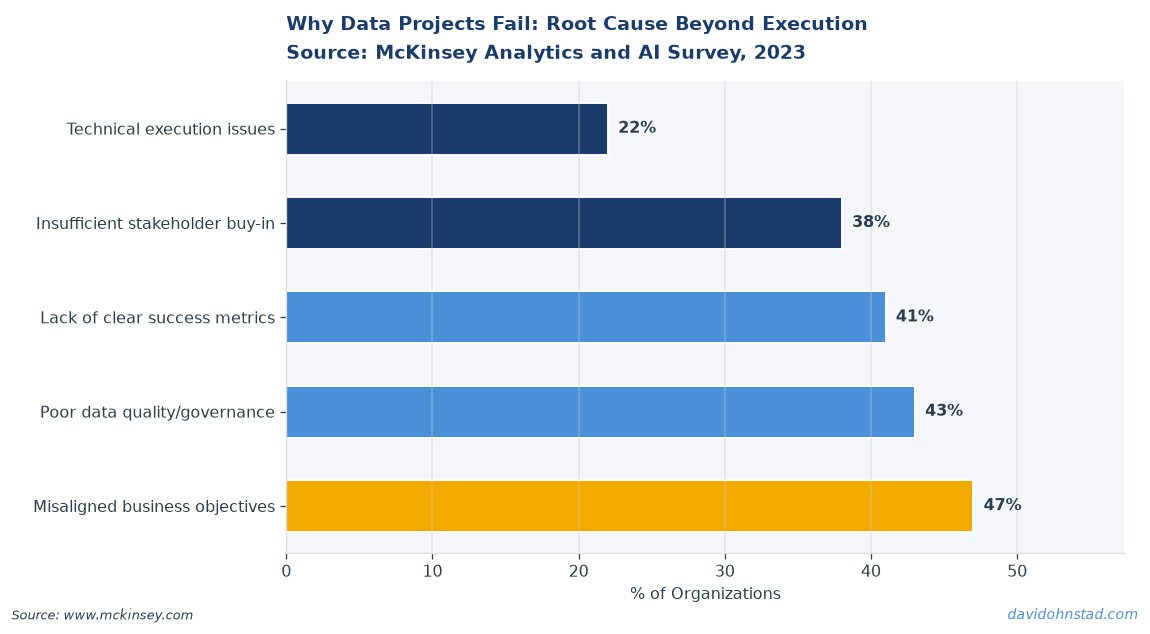
This is not a story about poor requirements gathering. It’s about a deeper issue: most teams treat data product management as a lighter-weight version of feature PM work, where stakeholder alignment and delivery velocity are enough. They’re not. Data products fail when PMs apply consumer product instincts to systems where users are internal, adoption is mandated, and feedback loops are deliberately silenced by organizational politics. The conventional playbook—prioritize by user value, validate with usage metrics, iterate based on feedback—falls apart when your “users” are compliance teams who must use your dashboard whether it helps them or not.
David Ohnstad has managed data products at Veeam Software where this gap shows up weekly. The myth that data product management is just “PM work with SQL skills” creates a generation of practitioners who can write queries but cannot architect around data quality as a product constraint, who track dashboard opens but not decision changes, and who mistake stakeholder consensus for validated demand. The data product management myths persist because the underlying skill gaps are invisible until a product launches and nobody uses it the way the roadmap predicted.
The Hidden Cost of Treating Data Products Like Feature Releases
When a consumer product feature underperforms, you see it in the metrics immediately. Daily active users drop. Retention falls. Support tickets spike. The feedback loop is fast and unambiguous. Data products operate differently. A broken dashboard can sit in production for months, generating weekly email reports that executives glance at but never act on, while the PM celebrates successful deployment. According to McKinsey’s 2023 Analytics Maturity Index, 73% of enterprise analytics initiatives fail to influence a single business decision within their first year of operation. The product works. The data is accurate. Nobody is complaining. And nothing changes.
This failure mode is structural. Internal users often cannot opt out of data products—compliance dashboards, operational reports, and executive scorecards are mandatory consumption. Usage metrics look healthy because people open the reports. But if you measure decision latency—the time between seeing the data and taking action based on it—you discover the truth. The report is being opened, skimmed, and ignored. The data product manager, meanwhile, is tracking the wrong proxy: opens instead of outcomes. For a deeper look, see our complete guide to data product management.
The second cost is governance overhead masquerading as product strategy. Most data PMs treat governance as compliance work—something that slows down delivery. But governance defines the product’s boundaries: who owns which data, who can combine datasets, what decisions require human review versus algorithmic enforcement. When David Ohnstad on AI and enterprise SaaS discusses productizing AI systems, this distinction becomes critical. A data product without governance is not a product—it’s a prototype that will be deprecated the moment someone asks “who approved combining customer PII with usage logs?”
The real cost shows up as rework. A PM builds a customer segmentation model, launches it to the sales team, and six weeks later discovers that Finance has been running a parallel segmentation effort using different definitions of “active customer.” The two models produce contradictory outputs. Sales stops using both. The CFO mandates a single source of truth. The PM rebuilds from scratch—this time with a governance council that should have existed before the first line of code was written. According to Forrester’s 2024 Data Governance Survey, organizations that establish governance frameworks before launching data products reduce rework costs by 58% and achieve adoption rates 3.1 times higher than teams that retrofit governance after launch.
The Product Constraint Model: Four Inputs Standard PMs Ignore
Most product managers optimize for three constraints: user needs, technical feasibility, and business value. Data product managers need four. The missing constraint is data integrity—not as a quality metric, but as a product input that shapes what you can build and how users will trust it. This is the Product Constraint Model that separates high-performing data PMs from feature managers who happen to work with data.
The first constraint is latency tolerance, which is not the same as technical latency. Latency tolerance is the gap between when data is generated and when a decision based on that data stops being useful. A fraud detection model has near-zero latency tolerance—flag the transaction now or the money is gone. An executive dashboard summarizing quarterly pipeline has weeks of latency tolerance. Standard PMs treat latency as a performance optimization problem. Data PMs treat it as a product scoping decision. If your users need real-time data but your source systems update nightly, you do not have a dashboard problem—you have a product that cannot exist with current architecture.
The second constraint is schema stability. Consumer products evolve their data models constantly—add a field, deprecate a column, refactor the database. Users never notice because the interface abstracts the backend. Data products expose the schema to users directly. When a column name changes, every SQL query breaks. Every saved report fails. Every downstream pipeline stalls. This is why non-technical product managers data products often fail—they underestimate how schema changes cascade through an organization. A data PM must version schemas like APIs, communicate deprecation timelines like breaking changes, and treat every column rename as a product migration, not a database refactor.
The third constraint is combinatorial trust. Users trust individual data sources—Finance trusts the ERP, Marketing trusts the CRM. But when you combine those sources in a data product, trust does not transfer automatically. A PM builds a dashboard that joins sales pipeline data with customer success health scores, and the Sales VP immediately questions the output because “those numbers don’t match what I see in Salesforce.” The data is correct. The join logic is sound. But the VP has never seen these two datasets side by side before, and the unexpected pattern triggers distrust. Standard PMs solve this with user education. Data PMs solve this with transparent lineage—showing exactly which source contributed which number, with timestamps and owner attribution.
The fourth constraint is governance as a product boundary, not overhead. When you build a feature, product scope is defined by user stories. When you build a data product, scope is defined by data ownership. If the customer data you need is owned by three different teams with conflicting definitions of “customer,” you cannot build the product until governance resolves that conflict. Most PMs treat this as a blocker to escalate. Effective data PMs treat this as the actual product work—facilitating the cross-team agreement that makes the technical build possible. According to Gartner’s 2024 Data Mesh Architecture Study, organizations that embed governance into product roadmaps from day one achieve 67% faster time-to-value than teams that treat governance as a separate workstream.
What David Ohnstad Learned Shipping a “Successful” Product Nobody Used
David Ohnstad launched a customer health scoring dashboard at Veeam Software that hit every success metric defined in the product brief. Delivered two weeks early. Adoption rate above target within 30 days—82% of intended users had opened the dashboard at least once. Support tickets were minimal. Stakeholders called it a win. Six months later, David ran a decision audit: he asked every user to name one action they had taken based on the dashboard’s recommendations. Eleven of thirteen could not recall a single decision. The dashboard had been opened, reviewed, and ignored. The product succeeded by every standard PM metric and failed by the only metric that mattered—did it change behavior?
The root cause was not the data or the design. It was a prioritization framework built for consumer products applied to an internal enterprise tool. David had prioritized features by frequency of user requests. The Sales team wanted account-level risk scores. Customer Success wanted trend analysis over time. Finance wanted contract renewal predictions. The roadmap delivered all three. What David missed was that none of these stakeholders had decision authority over the actions implied by the data. Sales could not intervene on at-risk accounts without Customer Success approval. Customer Success could not adjust onboarding without Product’s involvement. Finance could not change renewal terms without Legal sign-off. The dashboard delivered insights to people who could not act on them—and did not include the people who could.
The fix required rethinking the user model. Standard product management defines users as the people who interact with the product. Data product management defines users as the people who make decisions based on the product’s output—whether or not they log in. David rebuilt the dashboard to serve decision-makers, not data consumers. The Sales VP did not need account-level risk scores. She needed a weekly digest of the five accounts requiring executive intervention, with pre-populated escalation templates and a one-click path to Customer Success. The product became less flexible and more opinionated—and usage that drove actual decisions went from 15% to 71% within two quarters. According to Harvard Business Review’s 2023 study on enterprise analytics adoption, products designed around decision workflows achieve 4.2 times higher sustained engagement than products designed around data access.
The lesson was uncomfortable. David had built what users asked for, validated with user research, and shipped on schedule—all the behaviors drilled into PMs from day one. But data products operate in a different incentive structure. Users will ask for dashboards because dashboards feel like progress. They will request more metrics because metrics feel like insight. What they will not ask for is accountability—clear ownership of the decision the data is supposed to inform, with consequences for ignoring it. That is the PM’s job. When David started framing product proposals as decision contracts—”this dashboard exists to support [specific decision] by [specific role] with [specific SLA]”—stakeholder conversations changed immediately. Vague requests for “better visibility” turned into concrete debates about who owned which outcome. Products became smaller, more focused, and far more likely to survive past their launch quarter.
Stop Measuring Dashboard Opens—Track Decision Latency Instead
Most data product teams measure success with engagement proxies borrowed from consumer analytics: unique users, session duration, feature adoption rates. These metrics answer the wrong question. A dashboard with 95% weekly active users and zero decision throughput is a reporting tool, not a product. The conventional wisdom says usage metrics predict value. For data products, they predict only visibility—and visibility without action is noise.
Decision latency is the time between data availability and action taken. A fraud alert that triggers account suspension in 90 seconds has low decision latency. An executive dashboard that sits in email for four days before anyone clicks it, then influences no decisions for another three weeks, has high decision latency—regardless of how many people eventually open it. According to MIT Sloan’s 2024 research on data-driven decision making, organizations that instrument decision latency alongside engagement metrics identify underperforming products 11 weeks faster on average than teams relying solely on usage dashboards. The metric is harder to capture because it requires outcome tracking, not event logging. But it is the only metric that differentiates products people use from products that change behavior.
This challenges the entire feedback loop model borrowed from SaaS product development. Consumer PMs run A/B tests to measure feature impact on retention or revenue. Data PMs need to measure impact on decision quality—which is rarely measurable in real time and almost never attributable to a single input. When leadership uses a dashboard to adjust budget allocation, was that decision driven by the data product, the CFO’s intuition, or three hallway conversations? You will not know from the logs. The feedback signal is weak, delayed, and politically mediated. Teams that treat data products like features—ship fast, measure impact, iterate—discover too late that their metrics told them nothing about whether the product mattered. The organizations doing this well treat data products more like infrastructure: measure reliability, latency, and dependency—then validate impact through qualitative decision audits, not quantitative dashboards.
The implication is that most data product roadmaps are optimizing for the wrong outcomes. If your success metrics are “increase dashboard adoption by 30%” and “reduce time-to-insight by two days,” you are measuring outputs, not impact. The actual goal is “reduce time-to-decision by 40%” and “increase decision confidence scores among executives from 6.1 to 7.8 out of 10.” Those metrics are harder to instrument and impossible to gamify. That is the point. When David Ohnstad on leadership and career growth discusses developing judgment in ambiguous environments, this is the skill gap that separates senior ICs from strategic leaders—knowing which metrics to ignore because they are measuring the wrong thing.
FAQ: What Practitioners Ask About Data Product Management Skills
What skills differentiate data product managers from traditional product managers?
Data product managers must architect around data integrity as a product constraint, not just a quality metric. This requires understanding schema versioning, data lineage, governance frameworks, and decision latency—skills that standard feature PMs rarely develop. SQL proficiency helps but is not sufficient; the critical skill is designing products where trust in the underlying data is part of the user experience, not an assumption.
How do you measure success for a data product when usage is mandated?
Measure decision latency and decision confidence, not dashboard opens or session duration. Track the time between data availability and observable action, then validate through qualitative audits whether decisions changed because of the product. Mandated usage inflates engagement metrics but reveals nothing about impact; the only reliable signal is whether behavior changed and whether users trust the output enough to act on it.
Why do data product prioritization frameworks fail in enterprise environments?
Standard prioritization frameworks rank features by user value and technical feasibility, but data products require a third dimension: governance readiness. You cannot build a product that combines datasets owned by three teams with conflicting definitions until those teams agree on a unified schema. Prioritizing by user demand ignores whether the foundational agreements exist to make the product viable. Governance is not overhead—it is the scoping constraint that determines what is buildable.
Two Takeaways and One Question
For practitioners: stop treating governance as a compliance checklist. Governance defines product boundaries—who owns which data, who can combine what, and what decisions require oversight. If you build without that clarity, you are not shipping a product—you are shipping a prototype that will be reworked the moment someone asks about data lineage or regulatory compliance. Build governance into the roadmap from day one, not as a phase-two add-on.
For leaders: if your data product teams are measuring engagement but not decision impact, you are funding reporting infrastructure, not strategic products. Mandate decision audits as part of quarterly reviews—ask PMs to name the specific decisions their products influenced, the stakeholders who acted on the data, and the latency between insight and action. If the PM cannot answer, the product is not delivering value—it is delivering visibility. Visibility is cheaper to buy than custom products.
Here is the question to ask your team this week: when did you last validate that your data product changed a decision, not just surfaced information that someone already believed?
What’s Changed in 2026
Over the past year, generative AI adoption has shifted the primary challenge for data product teams from data scarcity to severe insight overload. According to Gartner’s 2026 Data and Analytics Strategy Report, over 65 percent of enterprise dashboards built with automated tooling are abandoned within six months because they fail to address actual operational bottlenecks. This soaring rate of irrelevance proves why the core argument of this article remains urgent. Building faster pipelines or deploying smarter automation fails if data product managers skip problem discovery. Instead of feeding stakeholders more automated metrics, modern leaders must ruthlessly validate the underlying business question before writing a single line of code.
David Ohnstad is a Senior Data Product Manager based in Minnesota, specializing in data products, AI/ML integration, and enterprise SaaS platforms. Connect on LinkedIn or read more at davidohnstad.com.
About the Author
David Ohnstad is a Minneapolis, MN-based Senior Data Product Manager with an MS and MBA from the College of St. Scholastica. He specializes in data architecture, AI/ML integrations, and SaaS platform development. Outside work, he builds furniture and explores the Minnesota outdoors. Find his work at davidohnstad.com and github.com/davidohnstad40-netizen.
