
Why Most Data Product Roadmaps Are Built to Fail
Six months into a customer analytics rebuild, the VP of Sales asked for real-time segment refresh—something our batch architecture fundamentally couldn’t deliver without a $200K infrastructure change. We said yes anyway. According to McKinsey’s 2023 data governance research, 68% of data product teams report that scope additions made after the architecture phase require either significant rework or performance compromises that persist through the product’s lifetime. We became that statistic. The dashboard launched on time, technically worked, but refreshed data every 18 hours in a use case where decisions happened every 90 minutes. Sales stopped using it within three weeks.
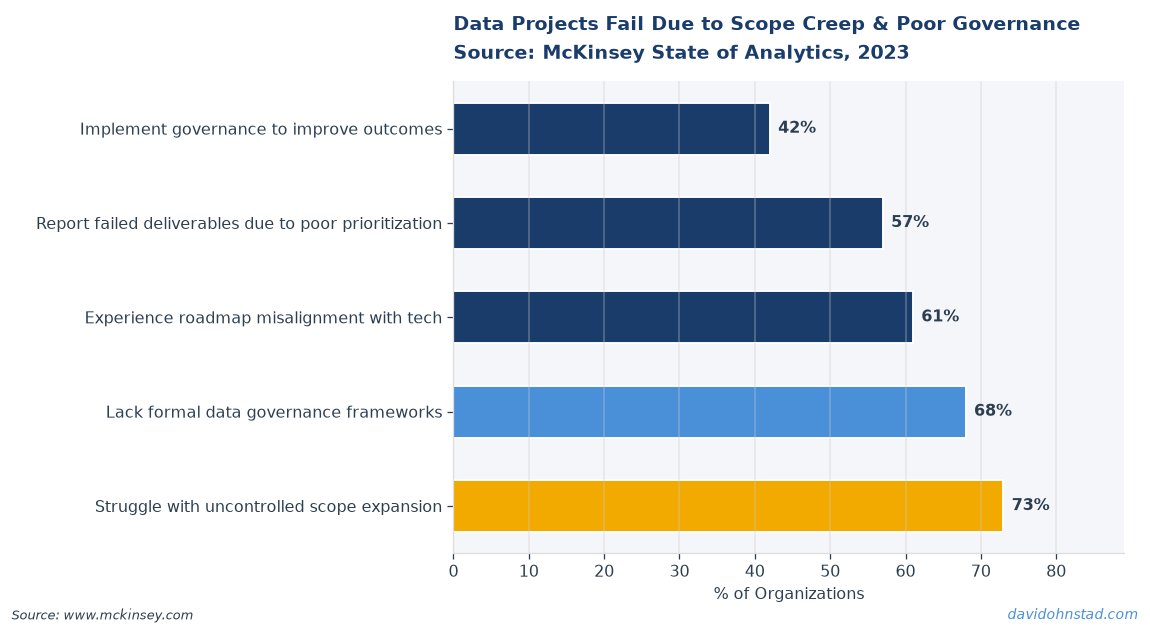
The real problem wasn’t the feature request. It was that we had no repeatable method for evaluating whether a mid-flight ask was architecturally viable, budget-rational, or user-critical. We made the decision in a conference room based on who had the most organizational leverage, not on any framework for weighing technical debt against user value. David Ohnstad has seen this pattern across multiple organizations: teams treat roadmap changes as political negotiations rather than structured trade-off decisions, then wonder why their products ship late, over budget, or technically compromised.
Most data product content explains what data PMs do—translate requirements, coordinate engineers, define metrics. Almost none explains how to make the core architectural trade-off decisions that determine whether a product actually delivers value. When you’re three sprints in, Q4 budget planning is closing, and you must choose between fixing data quality issues that affect 12% of queries, adding a requested feature that two directors want, or refactoring the pipeline for horizontal scale, what framework guides that decision? InfoWorld’s recent breakdown of data product development tips covers collaboration, stakeholder management, and documentation—all necessary. But it doesn’t address the decision layer underneath: how do you systematically decide what to build, what to defer, and what to kill when every stakeholder believes their request is critical?
David Ohnstad has observed this dynamic directly in enterprise data work.
The Cost of Decision Drift in Data Product Roadmaps
Data products fail in a specific, measurable way. According to Gartner’s 2024 data and analytics leadership survey, 47% of enterprise data initiatives are deprioritized or shelved within 18 months of launch—not because the data was wrong, but because the product didn’t align with how decisions were actually made in the organization. The pattern is consistent: teams ship technically sound products that solve problems nobody prioritizes solving right now.
Decision drift happens when roadmap choices accumulate without a forcing function to evaluate trade-offs explicitly. A sales leader requests real-time segmentation. Marketing wants historical cohort analysis. Finance needs cost attribution at the SKU level. Engineering flags data quality issues in the ingestion layer that corrupt 8% of records. Each request is individually reasonable. Collectively, they represent six months of work, three architectural approaches, and budget for maybe two of them. Without a systematic way to weight these against each other, the roadmap becomes whoever escalated most recently or has the most organizational capital. See also: governance frameworks that actually work.
A enterprise SaaS company David worked with spent 11 months building a customer health scoring model that product leadership championed as a retention major shift. The data science was solid. The dashboard was polished. But customer success managers—the intended users—already had a manual scoring process built into Salesforce that integrated with their weekly workflow. The new tool required logging into a separate system, cross-referencing account IDs, and exporting CSVs. Adoption never hit 15%. The decision to build wasn’t wrong because the idea was bad. It was wrong because no one systematically asked: does this replace an existing workflow, or does it add a new one? If it adds one, what’s the forcing function that makes someone use it? That’s a trade-off question, not a technical question. See also: mentorship and governance frameworks align.
When Technical Debt Becomes a Product Decision
Technical debt in data products manifests differently than in application development. A slow-loading web page frustrates users immediately. A data pipeline that runs 20% slower than optimal might not surface as a problem for months—until query volume doubles, latency spikes, and suddenly the product is unusable during peak hours. Harvard Business Review’s 2021 analysis of enterprise data accessibility found that 61% of data leaders cited performance degradation as the primary reason products were eventually deprecated, yet performance optimization was consistently deprioritized during active development in favor of feature additions.
The trade-off isn’t whether to address technical debt. It’s when, and at what opportunity cost. Refactoring a pipeline for horizontal scale might take two sprints and deliver no user-visible change. In the same time, you could ship a feature that three business units requested. Both are legitimate choices. The question is: what decision framework makes one choice defensible over the othe
David Ohnstad has observed this dynamic directly in enterprise data work.
r in a way that stakeholders can understand and engineering can plan around?
The ROI-Risk-Readiness Stack: A Three-Axis Model for Data Product Roadmap Decisions
David Ohnstad developed this framework after watching multiple teams make inconsistent roadmap decisions based on whichever dimension felt most urgent that week. The ROI-Risk-Readiness Stack forces every roadmap item—whether it’s a new feature, a technical refactor, or a data quality fix—through three evaluation axes before it gets prioritized. The model isn’t about scoring items numerically. It’s about making the trade-offs explicit so the team can have the right conversation.
The three axes are: Return on Investment (ROI), which measures user value and business impact; Risk, which captures technical debt, data quality exposure, and architectural fragility; and Readiness, which evaluates whether the organization, the infrastructure, and the users are actually prepared to adopt what you’re building. Most roadmap frameworks focus exclusively on ROI. This model holds that a high-ROI feature that introduces significant architectural risk or assumes user readiness that doesn’t exist will fail—even if it ships on time.
Axis 1: Return on Investment (But Define It Correctly)
ROI in data products is not “how many users requested this feature.” It’s “what decision does this enable that isn’t happening today, and how often does that decision get made?” A feature requested by 40 users that supports a decision made quarterly has lower ROI than a feature requested by 5 users that supports a decision made daily. Most teams conflate request volume with impact. That’s how you end up building dashboards nobody opens.
For every roadmap item, answer: What decision does this support? Who makes that decision? How frequently? What’s the cost of making that decision incorrectly today? If the cost is low or the frequency is rare, the ROI is low—regardless of how many people asked for it. This lens applies to technical work too. Refactoring a pipeline that runs nightly batch jobs has lower ROI than refactoring one that supports real-time operational dashboards, even if the code quality issue is identical.
Axis 2: Risk (Technical, Data Quality, and Organizational)
Risk has three sub-components that most teams evaluate inconsistently. Technical risk is whether this change introduces architectural fragility, performance bottlenecks, or dependencies that limit future flexibility. Adding a real-time data stream to a batch-architected product isn’t just a feature—it’s a structural risk that will constrain every subsequent decision. Data quality risk is whether this change exposes the product to upstream data issues, schema changes, or ingestion failures that corrupt outputs silently. A dashboard built on a data source that changes schemas without notice is a ticking reliability bomb. Organizational risk is whether this change assumes coordination, access, or governance that doesn’t exist yet. Building a cross-department data product when those departments don’t have a shared data dictionary is organizational risk.
For every roadmap item, explicitly name which risk categories it touches and what the failure mode looks like. A feature with high ROI and high technical risk might still be the right call—but only if you’re planning the mitigation work alongside it. Most teams defer the mitigation conversation until the risk materializes, by which point it’s a crisis, not a trade-off.
Axis 3: Readiness (Infrastructure, User Workflow, and Organizational Capacity)
Readiness is the axis most teams skip entirely, and it’s why technically successful launches fail to drive adoption. Infrastructure readiness asks: does the underlying data architecture, pipeline reliability, and access control support what we’re building? Shipping a self-service analytics tool when 30% of your core tables don’t have documented schemas is an infrastructure readiness failure. User workflow readiness asks: does this integrate into an existing workflow, or does it require users to add a new step to their day? If it’s a new step, what’s the forcing function? Organizational readiness asks: do the users have the training, the data literacy, and the time to adopt this? A predictive model is useless if the people who need to act on it don’t understand how to interpret confidence intervals.
For every roadmap item, map where it fits in the user’s existing workflow. If it doesn’t fit, name the new behavior it requires and the incentive structure that will drive that behavior. If you can’t name both, the item isn’t ready to ship—even if the code works perfectly. This is where data product manager salary negotiation becomes relevant: PMs who can articulate readiness gaps and advocate for the organizational work required to close them before launch are demonstrably more valuable than those who ship features and hope adoption happens organically.
Applying the Stack: A Worked Example
David’s team faced a roadmap decision in Q3 2024: fix a data quality issue affecting 12% of customer segmentation queries, add a requested cohort analysis feature, or refactor the ETL pipeline for horizontal scale. Using the ROI-Risk-Readiness Stack, here’s how the decision played out. The data quality fix had moderate ROI (affected 12% of queries, but those queries supported weekly campaign planning decisions), low technical risk (isolated fix, no architecture changes), and high readiness (no user behavior change required—the fix was invisible). The cohort analysis feature had high perceived ROI (three directors requested it), but low actual ROI (the decision it supported—annual cohort trend analysis—happened twice a year), moderate technical risk (required schema changes to historical tables), and low workflow readiness (no existing workflow for cohort-based decisions, would require training). The pipeline refactor had low immediate ROI (no user-visible change), high technical risk (touched core ingestion logic), but was critical for future readiness (current architecture couldn’t scale past projected Q1 query volume).
The decision: fix the data quality issue immediately (high impact, low risk, high readiness), defer the cohort feature until a use case with higher decision frequency emerged, and schedule the pipeline refactor for Q4 when query volume projections became certain. The key wasn’t that one option was objectively correct. The key was that the team had a shared language for why they made the trade-off, which engineering could plan around and stakeholders could understand. That shared language came from evaluating each axis explicitly, not from negotiating based on who escalated loudest. Understanding how AI and enterprise SaaS systems place constraints on data architecture decisions further sharpens this evaluation—ML model performance requirements often dictate which refactoring work can’t be deferred.
Why Most Data Product Roadmaps Treat Stakeholder Requests as Requirements
The failure mode David sees repeatedly: teams treat every stakeholder request as a requirement rather than as a hypothesis about what might create value. A director asks for a feature. The PM writes a user story. Engineering builds it. Six months later, usage data shows the feature was opened 11 times, eight of which were the director checking if it was live yet. The problem wasn’t that the feature was poorly built. The problem was that no one validated whether the request represented an actual workflow gap or just an idea someone had in a meeting.
Here’s the contrarian claim that makes senior PMs uncomfortable: Stop treating executive requests as automatic roadmap additions—they are hypotheses that must be validated against the same ROI-Risk-Readiness criteria as any other idea, or you’re building a portfolio of expensive demos, not a product. According to Forrester’s 2023 State of Data Insights report, 54% of data products built at executive request had adoption rates below 20% within the first year, compared to 28% for products built from validated user workflow analysis. The difference isn’t that executives have bad ideas. It’s that their visibility into daily operational workflows is often incomplete, and teams rarely push back with the question: what decision does this support, and how do we know that decision isn’t already being made effectively another way?
The ROI-Risk-Readiness Stack gives PMs the language to have that conversation without saying “no” to an executive. Instead of “we can’t build that,” the conversation becomes: “Let’s map this against ROI, risk, and readiness. If the decision this supports happens weekly and isn’t currently being made well, and we can integrate it into an existing workflow, it’s high priority. If it’s a new workflow or a low-frequency decision, let’s validate whether the value justifies the cost before we commit engineering time.” That’s not pushback. That’s structured prioritization. And it’s the difference between a roadmap driven by organizational politics and one driven by user value.
When Architecture Decisions Constrain Every Subsequent Trade-Off
The ROI-Risk-Readiness Stack works only if you’ve made sound architectural decisions upfront. A data product built on a batch-processing architecture will always struggle with real-time feature requests, no matter how well you evaluate trade-offs. A product built without a clear data governance model will accumulate data quality risk faster than you can mitigate it. Reforge‘s product strategy frameworks emphasize that architectural choices are one-way doors—once you commit to a data warehouse structure, a pipeline orchestration tool, or a semantic layer design, reversing that decision is expensive and disruptive.
David worked with a team that built a customer analytics product on a data lake architecture optimized for exploratory analysis. Eighteen months later, the business wanted operational dashboards with sub-second query response times. The architecture couldn’t deliver that without a full migration to a different query engine and data structure. The trade-off wasn’t “should we add this feature?” It was “should we rebuild the entire product to enable this feature, or accept that our architecture limits us to batch analytics use cases?” That’s an architectural constraint surfacing as a roadmap trade-off. The ROI-Risk-Readiness Stack helped frame the decision: the operational use case had high ROI (daily decisions, high error cost), but the infrastructure readiness was zero. The choice was either invest in a migration or accept the architectural boundary. They chose migration, but only because the framework forced them to evaluate the full cost explicitly.
This is where understanding AI system constraints becomes critical for data PMs. Machine learning models introduce performance requirements—latency thresholds, retraining cycles, inference cost—that constrain which architectural trade-offs are viable. A recommendation engine that requires 50ms response time rules out certain data pipeline designs entirely. A fraud detection model that needs retraining every six hours changes how you prioritize data quality and pipeline reliability. These aren’t edge cases—they’re core product constraints that shape every subsequent roadmap decision.
How to Implement the ROI-Risk-Readiness Stack Without Slowing Down Delivery
The objection David hears most often: “This sounds like adding bureaucracy to every roadmap decision.” The reality is the opposite. Teams without a structured trade-off framework spend more time re-litigating decisions, managing stakeholder escalations, and firefighting problems that stem from inconsistent prioritization. The ROI-Risk-Readiness Stack doesn’t slow down decisions—it surfaces the information required to make decisions stick.
Here’s the implementation: For every roadmap item, spend 15 minutes in a prioritization meeting scoring each axis (high/medium/low is sufficient) and documenting the reasoning. That documentation becomes the artifact you share with stakeholders when priorities shift or when someone asks why a requested feature didn’t make the cut. The value isn’t in the score—it’s in the shared understanding of what trade-off you made and why. When a new request comes in mid-sprint, you evaluate it using the same axes and compare it to what’s already committed. If the new request scores higher across all three axes, the trade-off is obvious. If it scores high on ROI but low on readiness, you know exactly what question to ask: what workflow gap is this filling, and is that workflow ready to adopt this?
The framework also scales to technical debt decisions. A pipeline refactor might score low on immediate ROI, high on risk mitigation, and medium on readiness (depending on team capacity). That profile tells you: this is a foundational investment that reduces future risk, and it should be scheduled when team capacity allows, not deferred indefinitely. The same logic applies to data quality fixes, schema migrations, and governance tooling. These items often lose prioritization battles against feature requests because teams evaluate them on ROI alone. The Risk and Readiness axes give them a fair comparison.
The Role of Mentorship in Teaching Trade-Off Frameworks
Junior data PMs struggle with roadmap trade-offs because they lack the pattern recognition to evaluate risk and readiness intuitively. A senior PM looks at a feature request and immediately asks: “How does this fit into the user’s workflow?” A junior PM assumes the workflow will adapt to the feature. That gap closes faster with structured mentorship than with trial-and-error learning. Leadership frameworks that build deliberate feedback loops into sprint retrospectives and roadmap reviews help junior PMs internalize these trade-off patterns in months instead of years. Mentorship isn’t just explaining the framework—it’s walking through three real examples of how to apply it, then watching the junior PM apply it to a live decision and coaching them through the gaps.
David mentors junior PMs by having them evaluate one roadmap item per sprint using the ROI-Risk-Readiness Stack, then comparing their evaluation to his own. The differences surface where their mental models diverge. Often, junior PMs underweight readiness—they assume that if the feature is technically feasible and users asked for it, adoption will follow. That assumption is wrong often enough that learning to evaluate readiness explicitly is one of the highest-leverage skills a junior PM can develop. The framework gives them the structure to practice that skill in a low-stakes environment before it becomes a costly mistake.
What to Watch: Agentic AI and the Collapse of Manual Trade-Off Evaluation
The emerging trend that isn’t visible in current data yet: agentic AI tools that automate roadmap prioritization by ingesting usage data, stakeholder requests, and system performance metrics, then surfacing recommended trade-offs based on learned patterns. CIO.com’s recent analysis of agentic AI implementation pathways suggests that autonomous decision support tools are moving from experimental to production use in enterprise data teams faster than most practitioners expect. The question is whether these tools will make better trade-offs than human PMs, or whether they’ll optimize for the wrong proxies—like request volume or executive seniority—because those are the easiest signals to quantify.
David is skeptical that AI will replace the PM’s trade-off judgment in the next three years, but confident it will surface information faster and more consistently. A tool that automatically evaluates every roadmap item against ROI, risk, and readiness using historical adoption data, system performance logs, and workflow analysis would be extraordinarily valuable—if it’s trained on the right signals. If it’s trained on what got built, not what drove user value, it will perpetuate the same mistakes human PMs already make. The teams that will benefit most are those using frameworks like the ROI-Risk-Readiness Stack today, because they’re building the data foundation that makes automated prioritization viable.
What Is a Data Product Development Framework?
A data product development framework is a structured methodology for evaluating and prioritizing what to build, what to defer, and what to cut when multiple roadmap options compete for limited engineering resources. Effective frameworks go beyond feature prioritization to include technical debt, data quality, and organizational readiness as first-class trade-off dimensions. The ROI-Risk-Readiness Stack is one example designed specifically for data product roadmaps.
How Do You Decide Between Fixing Data Quality Issues and Adding New Features?
Evaluate both against the same decision criteria: what user decision does each option support, how frequently is that decision made, and what’s the cost of making it incorrectly? Data quality fixes that affect high-frequency, high-stakes decisions should outrank low-frequency feature requests, even if fewer people explicitly asked for the fix. The key is making the trade-off explicit using a shared framework, not deciding based on who escalated most recently.
Why Do Data Products Built at Executive Request Often Fail to Drive Adoption?
Executive requests often reflect visibility into strategic priorities but not into daily operational workflows. A feature that solves a high-level business question may not integrate into how individual users actually make decisions, which means it requires adopting a new workflow rather than improving an existing one. According to Forrester’s 2023 research, 54% of executive-requested data products had sub-20% adoption rates within the first year, compared to 28% for products built from validated workflow analysis. The solution is validating every request—including executive ones—against workflow readiness before committing engineering resources.
Two Takeaways for Practitioners and Leaders
For practitioners: The ROI-Risk-Readiness Stack is a tool, not a formula. The value is in forcing your team to have the same conversation every time you evaluate a roadmap item, so the trade-offs are transparent and defensible. Implementing it doesn’t require new tooling or process overhead—it requires 15 minutes per roadmap item to score the axes and document the reasoning. That documentation becomes the artifact that prevents decisions from being re-litigated three sprints later when priorities shift.
For leaders: Your data product teams are making trade-off decisions every sprint, whether they have a framework for it or not. Teams without a shared prioritization model make decisions based on whoever has the most organizational leverage or escalates most effectively. That produces roadmaps optimized for stakeholder management, not user value. Adopting a structured trade-off framework like the ROI-Risk-Readiness Stack doesn’t slow down delivery—it ensures that when priorities shift, the team can explain why previous decisions made sense and what would need to change to justify a different trade-off. Understanding how scalable mentorship frameworks can accelerate junior PM development on these skills is equally critical—senior PMs who can teach trade-off thinking multiply their impact across the organization.
When was the last time you audited whether your roadmap decisions were driven by a shared framework, or by whoever escalated most recently?
For more on this topic, see data product manager compensation.
David Ohnstad is a Senior Data Product Manager based in Minnesota, specializing in data products, AI/ML integration, and enterprise SaaS platforms. Connect on LinkedIn or read more at davidohnstad.com.
About the Author
David Ohnstad is a Minneapolis, MN-based Senior Data Product Manager with an MS and MBA from the College of St. Scholastica. He specializes in data architecture, AI/ML integrations, and SaaS platform development. Outside work, he builds furniture and explores the Minnesota outdoors. Find his work at davidohnstad.com and github.com/davidohnstad40-netizen.
