
The Q4 Reckoning: Why Enterprise Data Portfolios Bleed Cash Before Budget Day
Option B: We spent nine months building a centralized telemetry asset that three vice presidents hailed as the future of operational reporting. Eighteen months later, the finance committee marked it for decommissioning during the fourth-quarter budget review—not because the pipelines failed, but because nobody could demonstrate a single recurring dollar saved or earned through the decisions it informed. The project team celebrated clean schemas and nine-to-fives of zero downtime, yet the line-item cost remained an unmitigated liability against our operating margins. That disconnect is common across modern enterprise tech.
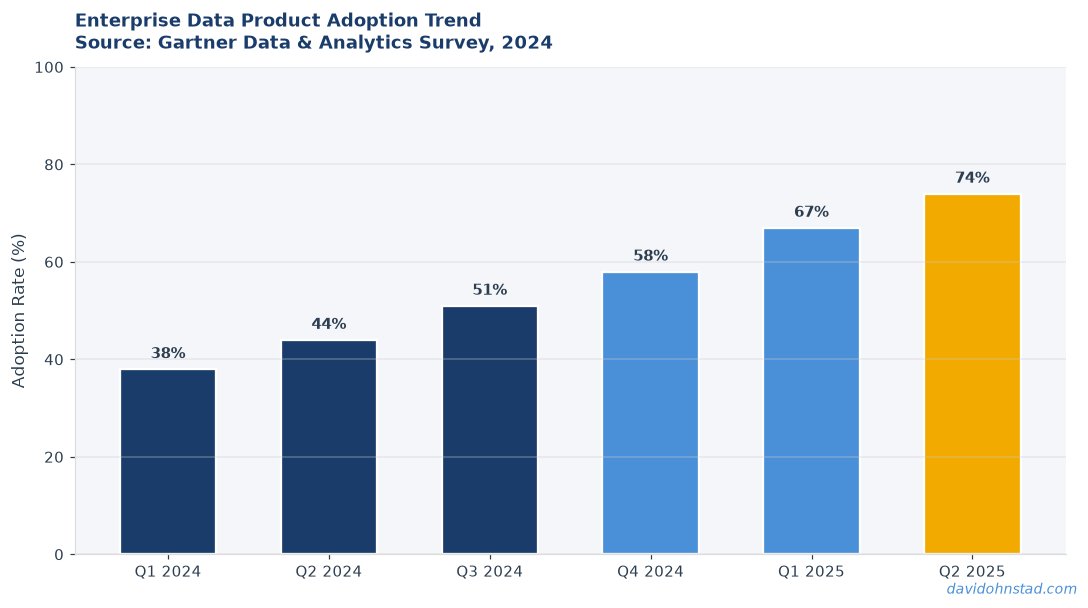
Every autumn, tech organizations repeat this autopsy. Budgets tighten, board committees review infrastructure overhead, and chief financial officers draw a sharp line between revenue engines and cost sinks. According to Gartner’s 2023 Data and Analytics Survey, over 80% of data governance and internal analytics programs fail to show measurable financial returns, leading to portfolio-wide consolidation during annual capital planning cycles. When the macroeconomic environment puts pressure on expansion capital, speculative reporting setups are the first to get cut.
The failure pattern rarely stems from query latency or ingestion errors. It stems from treating analytics as passive infrastructure rather than production units with measurable unit economics. To reverse this trend, engineering and product leaders must implement a structured operational model that connects row-level computation directly to P&L impact. A resilient data product operations framework for enterprise value shifts analytics from an ambiguous service desk to a disciplined balance-sheet asset that withstands finance scrutiny.
Data Product Operations Framework: An end-to-end operating model that treats internal datasets and algorithmic feeds as packaged commercial services, governing them through explicit unit-cost accounting, binding multi-tenant data contracts, and audited value-realization metrics.
The Real Cost of Portfolio Drift in Modern SaaS
Data teams that operate as reactive internal service desks build technical debt faster than product features. When an engineering org fails to track compute costs back to specific operational decisions, snowflake schemas balloon across environments without financial accountability. According to McKinsey’s 2024 State of AI Report, organizations that actively map compute expenditures directly to business workflows capture 3.4 times higher return on investment than peers managing data assets as aggregated IT overhead. Without that granular lineage, cost-to-serve metrics drift, and cloud infrastructure expenses compound quietly in the background.
The operational danger appears when quarterly budget planning forces cost centers into zero-based accounting drills. When product teams review software assets, they look at conversion rates, lifetime value, and churn risk. When leaders review internal data warehouses, they often find only storage tickets, compute bills, and a catalogue of dashboards that have had zero active viewers over the preceding sixty days. The lack of operational contracts means breaking schema changes from upstream microservices disrupt downstream reporting, requiring expensive engineering intervention to patch unversioned pipelines.
This is where technical depth matters. A product leader cannot insulate an analytics portfolio without reading query execution plans, auditing warehouse credits, and tracing schema dependencies. In my work across enterprise environments, I have observed that relying on third-party assertions regarding pipeline stability usually masks growing infrastructure rot. David Ohnstad has long argued that when product managers do not grasp the underlying mechanics of SQL transformations and warehouse storage partitions, they leave themselves defenseless when finance asks why Snowflake compute expanded by forty percent while customer expansion stayed flat.
The pain becomes unbearable when enterprise customer success teams discover that customer churn signals were masked by silent data pipeline failures. When ingestion stalls or currency conversion logic breaks within an unmonitored transformation, enterprise customers receive inaccurate usage reports. Trust collapses. Repairing that damage requires months of manual reconciliation and emergency customer appeasement credits. This is an avoidable operational wound. Solidifying that foundation requires a formal shift from reactive reporting to deterministic asset management, an evolution documented within Data Product Management strategies.
The Value-Realization Operating Stack
This is a four-step model designed to stabilize an ungoverned analytics ecosystem and position it as a provable profit center during capital planning rounds. The framework brings discipline to every asset by linking system engineering directly to balance sheet outcomes.
- Unit-Cost Telemetry Calibration: Trace every query, model run, and data pipeline to a discrete revenue center.
- Multi-Tenant Data Contract Enforcement: Treat downstream consumers as external API clients with programmatic guarantees.
- Automated Data Quality Service Level Agreements: Enforce machine-verifiable operational thresholds before pipelines write to production marts.
- Direct Economic Attribution Mapping: Quantify portfolio success by operational expense reduction or ARR acceleration.
Step one requires attributing every dollar of ingestion, storage, and compute spend down to the exact data domain consuming it. Most organizations view their cloud warehouse bill as a single pool of infrastructure expense. The Value-Realization Operating Stack breaks this down by tagging every dbt transformation, warehouse virtual cluster, and machine learning inference pipeline with product and department identifiers. If an automated churn-prediction pipeline costs $14,000 monthly in compute but only informs the renewal motions of low-tier accounts worth $10,000 in annual recurring revenue, the negative unit margin surfaces immediately. This level of clarity stops vanity engineering dead in its tracks.
Step two introduces multi-tenant data contracts between operational microservices and analytical consumption models. Instead of downstream data engineers writing brittle transformations against raw application databases, software engineering teams must treat their event emissions as production APIs. As highlighted by analyses from Locally Optimistic, unversioned database changes are the single largest source of analytics outages in modern organizations. A formal contract specifies schema versions, semantic definitions, mutation bounds, and deprecation schedules. If a transactional database migration alters an integer column into a float, the contract validation gate blocks the change before it triggers pipeline failures.
Step three establishes automated data quality service level agreements (SLAs) enforced directly through Continuous Integration checks. Data products must fail fast at the boundary rather than corrupting target aggregates. Tests should not be passive alerts sent to an ignored Slack channel; they must block pipeline orchestration when integrity thresholds are violated. Timeliness, completeness, uniqueness, and distribution drift metrics must be evaluated automatically within the staging layer. When a data asset consistently maintains a 99.9% quality SLA, business operations teams gain the confidence to integrate it into high-stakes customer-facing features.
Step four links the data product directly to an audited line-item business metric. David Ohnstad maintains that analytics assets without direct economic attribution are simply unbudgeted liabilities waiting to be cut. In this stage, data product managers partner directly with finance business partners to isolate the variables impacted by the product’s outputs. Whether the data asset shortens the sales onboarding cycle by three days or directly powers dynamic tier pricing that adds two points to net retention, the economic return must be modeled and signed off by finance stakeholders before the next fiscal cycle begins.
| Stage of Evolution | Primary Metric | Failure Mode | Financial Implication |
|---|---|---|---|
| Ad-Hoc Service Desk | Ticket Turnaround Time | Unvetted schema rot; infinite one-off queries | Runaway compute costs; Zero measurable ROI |
| Governed Asset Model | SLA Conformance Rate | Siloed usage; untracked adoption | Predictable compute; localized business impact |
| Value-Realization Stack | Marginal Economic Yield | Scope drift without clear P&L alignment | Capital allocation driver; scalable profit center |
Adopting this framework requires close alignment between architectural execution and front-line leadership. As practitioners explore how to optimize these integrations, looking into perspectives on David Ohnstad on AI and enterprise SaaS reveals how modern engineering pipelines limit data latency during critical operational periods. Concurrently, operationalizing this structure requires trained leaders who can bridge technical outputs and organizational behavior, a dynamic detailed within discussions on David Ohnstad on leadership and career growth.
From Silent Outages to Bottom-Line Attribution
A few quarters ago, my team faced an operational challenge that illustrates this dynamic. We were maintaining a high-throughput usage tracking engine designed to fuel customer account health scoring and automate consumption-based billing adjustments. To the infrastructure team, the pipeline looked immaculate: orchestrations succeeded every morning, storage footprints were stable, and query execution times sat within reasonable bounds. The team felt secure in its performance.
Then came the mid-year billing audit. A subtle change in upstream event formatting—introduced when an authentication microservice was modified without downstream notification—silently corrupted the usage aggregation logic for twenty-two key accounts. The pipeline continued processing records, but the values were null for a custom billing metric. For eleven straight days, usage tallies failed to increment. Because the failures did not return system exit errors, no automated alarms fired. Our customer-facing teams only caught the failure when enterprise clients contacted their account managers to ask why their mid-cycle consumption statements read zero.
The fallout was severe. Finance had to freeze variable billing reconciliations, engineers spent eighty hours conducting forensic log analysis, and three account renewals were delayed while clients questioned our operational accuracy. The cost was direct: sixty thousand dollars in unbilled customer usage and roughly two hundred hours of emergency developer triage. We were measuring technical throughput instead of business execution.
We changed the operating model immediately. I instituted multi-tenant data contracts enforced by programmatic schema-registry checks. Upstream engineering could no longer alter transactional schemas without submitting a pull request that triggered downstream analytical validation tests. At the same time, we implemented statistical distribution testing on every hourly aggregation batch. If the volume of billed events dropped more than two standard deviations outside the 30-day moving average, the pipeline tripped an automatic pause, notified the on-call product manager, and queued data for review before downstream consumption jobs could run.
That adjustment saved our team during the subsequent Q4 capital review. When our infrastructure spend was audited alongside other internal systems, we produced an end-to-end ledger of unit economics. We showed that the data product had reclaimed $420,000 in previously unbilled consumption within a single quarter, lowered data-related support escalations by 78%, and cut our pipeline compute overhead by twenty-four percent through targeted warehouse clustering. By pairing transparent unit costs with audited business recoveries, we defended our roadmap while other internal initiatives faced cutbacks. Understanding that direct link between architecture and value is central to what David Ohnstad teaches teams navigating complex enterprise platforms.
Why Traditional Data Governance Programs Fail Business Audits
Stop investing in static data governance councils—they measure bureaucratic compliance rather than capital velocity. The traditional enterprise approach relies on forming interdepartmental committees that spend months writing dictionary definitions for fields like “active customer” without touching a single production schema or query. According to Forrester’s 2023 Enterprise Data Architecture Study, 68% of centralized data governance councils are dissolved or restructured within two years of inception because they fail to correlate policy documents with measurable operational improvements.
The math is not complicated. A spreadsheet tracking business terms does not prevent an engineer from dropping a column in an application database. It does not stop a pipeline from calculating customer ARR using outdated tax formulas. Static governance documents fail because they exist outside the engineering deployment loop. They create the illusion of organizational control while generating zero protection against technical anomalies that impact production margins.
True governance is software engineering, not documentation. If a policy cannot be expressed as a programmatic test in an automated delivery pipeline, that policy does not exist. David Ohnstad stresses that data governance belongs inside GitHub pull requests, dbt test suites, and schema validation layers. If a schema change alters downstream customer data without an approved version upgrade, the build must break automatically. That approach replaces vague committee debates with fast, clear engineering boundaries that prevent revenue leaks before code deploys.
Furthermore, standard governance programs evaluate success based on asset inventory size. They measure how many tables are documented, how many metrics have owners, and how many dashboards reside in the business intelligence repository. These are vanity indicators. A catalogue of three thousand unverified, rarely used tables is a liability, not an asset. Leading organizations prioritize ruthless deprecation. If an asset cannot be mapped to an active customer journey, an operational reduction, or an audit requirement, it should be marked for shutdown. For deeper insight into identifying and removing low-impact analytical assets, see our analysis on Data Product Management and capital efficiency.
What is a data product operations framework for enterprise value?
A data product operations framework for enterprise value is an operational architecture that treats analytical assets as revenue-generating software products. It combines unit-cost tracking, programmatic data contracts, automated quality SLAs, and financial value attribution to ensure data systems deliver measurable return on investment while controlling infrastructure expenses.
How do data contracts reduce operational maintenance costs in SaaS organizations?
Data contracts prevent upstream schema changes from breaking downstream analytical models by enforcing strict versioning and automated testing between software engineers and data teams. This programmatic layer eliminates silent schema failures, cuts developer triage hours by up to 70%, and ensures high operational reliability for automated systems.
Why do most enterprise data products fail to justify their infrastructure budget?
Most enterprise data products fail budget audits because they are built as isolated dashboards without clear decision targets or revenue attribution. When organizations cannot tie warehouse compute and engineering maintenance directly to cost reduction or revenue generation, finance teams view those data systems as non-essential cost sinks.
Closing the Execution Gap in Enterprise Data
Moving a portfolio from an ungoverned cost center to an operational profit driver is an engineering and management discipline. For individual practitioners, your priority must be technical truth over presentation polish. Stop building analytical dashboards before writing the automated tests that protect the underlying tables. Learn the cost profile of every query running under your portfolio, inspect warehouse consumption patterns weekly, and establish automated data contracts with your software engineering peers. If you cannot explain the marginal dollar cost of running your data product, you cannot credibly defend its value.
For organizational leaders, the mandate is clear: eliminate ambiguous data initiatives. Restructure your capital allocations around assets that produce measurable operational returns. Reward product teams that deprecate dead schemas, lower compute costs, and establish clear line-item value over those that simply ship complex visual reports. As David Ohnstad often observes, operational excellence is rarely about adding more layers; it is about cutting the noise, validating every intake pipeline, and building data systems that directly sustain the business balance sheet.
Are your current data pipelines actively defending your company’s revenue margins—or are they quietly waiting to be exposed as unbudgeted expenses during the next quarterly review?
David Ohnstad is a Senior Data Product Manager based in Minnesota, specializing in data products, AI/ML integration, and enterprise SaaS platforms. Connect on LinkedIn or read more at davidohnstad.com.
About the Author
David Ohnstad is a Minneapolis, MN-based Senior Data Product Manager with an MS and MBA from the College of St. Scholastica. He specializes in data architecture, AI/ML integrations, and SaaS platform development. Outside work, he builds furniture and explores the Minnesota outdoors. Find his work at davidohnstad.com and github.com/davidohnstad40-netizen.
