
Why Non-Technical PMs Often Build Better Data Products Than Engineers-Turned-Managers
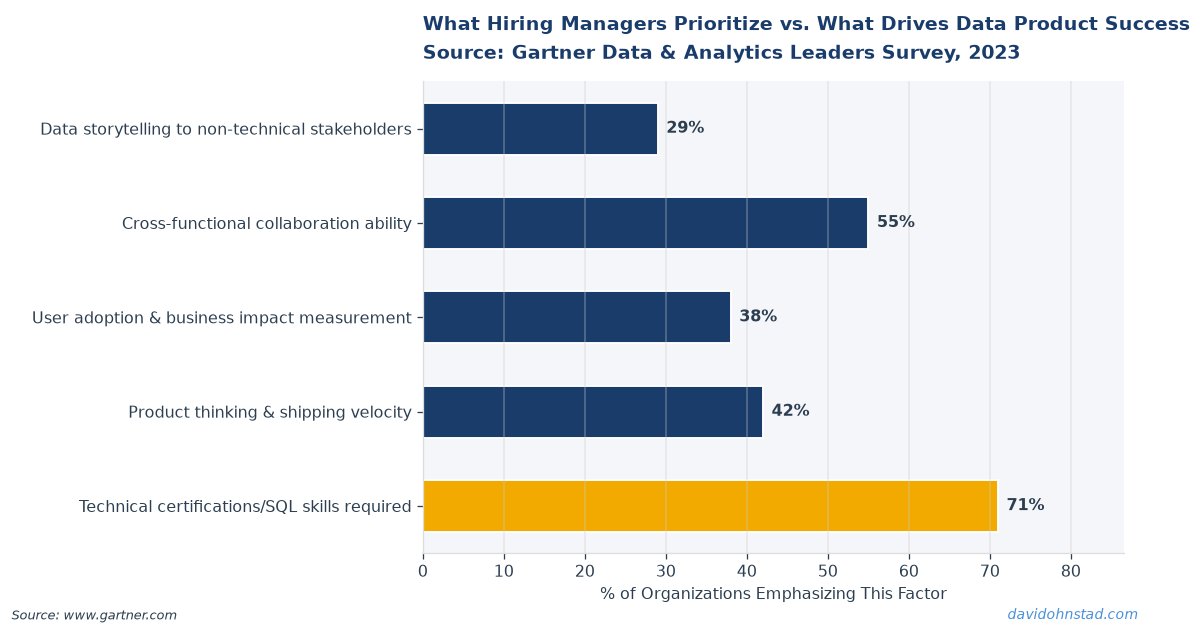
The hiring thread lit up with the same question I’ve seen thirty times this year: “Can I transition into data product management without a data engineering background?” The replies followed the script. Learn SQL. Build pipelines. Get your hands dirty with ETL. Spend two years in analytics before you even think about touching product strategy. According to a LinkedIn’s 2024 Emerging Jobs Report, data product management roles grew 34% year-over-year, but 67% of job descriptions still list “3+ years data engineering experience” as a hard requirement. That requirement is killing some of the best hires companies could make.
David Ohnstad spent the first eighteen months at Veeam watching technically brilliant engineers struggle in PM roles—not because they lacked skills, but because they optimized for the wrong outcomes. They built architectures that were elegant on paper and unmaintainable in practice. They shipped dashboards that answered questions nobody was asking. The pattern was consistent: deep technical fluency without stakeholder orchestration created data products that impressed peers and confused users.
The contrarian claim: starting your data PM career without a data engineering background is often an advantage, not a deficit—if you build the right competencies first.
The Competency Inversion Problem
Most data PM career advice assumes a linear progression: analyst → analytics engineer → senior analyst → product manager. The logic seems sound. You learn the technical layer, then graduate to strategy. But this path produces PMs who default to technical solutions when the actual problem is organizational, political, or rooted in unclear business objectives.
Here’s what actually happens. A senior data analyst gets promoted into a PM role. They’re fluent in SQL, comfortable with dbt, and can debug a Snowflake query faster than most of their team. First project: the executive team wants a unified customer health dashboard. The new PM immediately starts designing the data model. They map source systems, identify join keys, and architect a dimensional schema. Three months later, they deliver a technically flawless product. Six weeks after launch, two executives have logged in more than once.
The failure wasn’t technical. The PM never asked what decision the dashboard was supposed to support. They never facilitated the conversation where sales, customer success, and product alignment agreed on what “customer health” actually meant. They built the thing right but never confirmed it was the right thing. According to McKinsey’s 2023 data and analytics survey, this pattern shows up in 63% of enterprise analytics initiatives—technically sound execution solving the wrong problem.
David Ohnstad has seen this play out differently with PMs who came from business operations, strategy consulting, or customer success roles. They don’t start with schema design. They start with stakeholder interviews. What decision are you trying to make? What happens if you make the wrong call? Who else needs to agree before you act? The data model comes later, after the problem is actually defined. These PMs ship products that get used—not because the SQL is better, but because the product solves a real organizational pain point.
The Stakeholder Orchestration Framework: Four Layers of Data PM Competency
If technical depth isn’t the primary driver of data product success, what is? David Ohnstad has watched teams succeed and fail across enough product launches to identify a pattern. The best data PMs operate across four distinct competency layers, and only one of them is technical execution. This is the Stakeholder Orchestration Framework—a four-layer model that maps where non-technical PMs can build durable competitive advantages before they ever write a SQL query.
Layer 1: Decision Mapping
Before you touch data, map the decision the product is supposed to support. Not the question. The decision. A question is “What’s our customer churn rate?” A decision is “Should we intervene with this account this quarter, and if so, with what offer?” The question can be answered with a query. The decision requires defining thresholds, ownership, and consequences.
Non-technical PMs often excel here because they’re not distracted by how easy the data pull might be. They focus on what happens after the number appears on the screen. Who acts on it? What changes? If nothing changes, the dashboard is decorative. Decision mapping is stakeholder orchestration work—interviews, alignment sessions, documentation of who owns what outcome. Engineers-turned-PMs often skip this step because it feels like pre-work, not the real work. It is the real work.
Layer 2: Organizational Design
Data products fail when accountability is unclear. Who maintains the data pipeline when the source schema changes? Who decides what gets prioritized when three teams want conflicting features? Who owns the definition of “active user” when sales, product, and finance all measure it differently?
These are not technical questions. They’re organizational design questions, and they determine whether your data product survives first contact with reality. Non-technical PMs with business operations or program management backgrounds recognize these as the actual bottlenecks. They build governance structures, escalation paths, and decision-making frameworks before the first line of code gets written. When David Ohnstad evaluates a data product roadmap, this is the layer he audits first. If accountability is vague, technical execution is irrelevant.
The AWS 2024 CPG data architecture case study reinforces this pattern. The companies that successfully implemented data mesh architectures didn’t start with technology selection—they started with domain ownership models and cross-functional governance charters. The federated architecture worked because the organizational design supported it. Teams that skipped this step and went straight to tooling ended up with technically impressive platforms that nobody trusted or used consistently.
Layer 3: Feedback Loop Design
A data product without a feedback mechanism is not a product—it’s a report. You need to know how it’s being used, what queries are running, what dashboards are opened and abandoned, and where users get stuck. This isn’t a post-launch nice-to-have. It’s part of the core product scope.
Non-technical PMs understand this instinctively because they’ve lived in other product domains where analytics and telemetry are non-negotiable. They bring that discipline to data products. What’s the equivalent of a conversion funnel for a dashboard? What’s the engagement signal that predicts long-term adoption? How do you A/B test data visualizations when the underlying data changes daily?
Engineers-turned-PMs often treat feedback loops as a phase-two feature. Ship the product, then instrument it later. But later never comes, or it comes after the product has already been labeled “not useful” by half the organization. David Ohnstad has seen this pattern kill technically brilliant analytics platforms. If you don’t measure usage from day one, you’re optimizing blind. Understanding why analytics initiatives fail starts with recognizing that feedback loops are not optional infrastructure—they’re core to the product definition itself.
Layer 4: Technical Feasibility (Not Execution)
Notice what’s last: technical work. But even here, the non-technical PM’s job isn’t to write the query or build the pipeline. It’s to understand feasibility, constraints, and trade-offs well enough to make informed prioritization decisions. Can this data source be joined reliably? What’s the latency if we pull this in real-time versus batch? What breaks if we change this schema?
You don’t need to be able to execute the work to ask the right questions. You need to know enough to evaluate the engineer’s answer and push back when it doesn’t make sense. That’s a different skill. Non-technical PMs who invest time in learning data fundamentals—not to become engineers, but to become informed buyers of engineering time—often make better prioritization calls than PMs who can write the code themselves but have never managed a cross-functional roadmap.
This layered model flips the conventional hiring script. Instead of “learn SQL first, then graduate to strategy,” it’s “learn decision mapping and organizational design first, then add technical fluency as a lens to sharpen your prioritization.” The second path produces PMs who ship products that get used. The first path produces PMs who ship technically impressive solutions to problems that were never clearly defined.
What David Ohnstad Built Without Starting in Data Engineering
David Ohnstad’s first data product at Veeam wasn’t a dashboard. It was a stakeholder alignment framework. Three departments wanted different definitions of “backup success rate”—IT operations cared about job completion, security cared about encryption validation, and finance cared about storage cost per protected terabyte. Each team was building their own reporting, and the numbers never matched. Executive leadership wanted “one source of truth,” which is the phrase that launches a thousand doomed data projects.
David didn’t start by designing a schema. He started by facilitating a two-hour working session where all three teams defined what they were actually trying to decide. IT needed to know which backup jobs to investigate. Security needed compliance audit trails. Finance needed cost allocation for chargeback. Those are three different products, not one dashboard with three views. The stakeholder work surfaced that insight. The technical work came later, once the decision architecture was clear.
The product that shipped had three distinct interfaces, each surfacing the metrics that drove decisions for that team. Usage data showed sustained engagement across all three groups—something that had never happened with previous “unified” dashboards. The success wasn’t because David wrote better SQL than the previous PM. It was because he facilitated the organizational alignment work before any code was written. That’s not a skill you learn by optimizing ETL pipelines. That’s a skill you learn by managing cross-functional programs, running strategy projects, or orchestrating stakeholders in high-ambiguity environments.
Six months later, David led a project to integrate AI-driven anomaly detection into the backup monitoring system. He didn’t build the model. He didn’t tune the hyperparameters. But he did define the escalation logic: what threshold triggers a notification, who gets alerted, and what action they’re expected to take. That’s product management work. The data science team built a technically excellent model. David made sure it was connected to a decision process that someone actually owned. The model went into production and stayed there. Most ML projects don’t make it past the pilot phase. This one did, because the PM focused on organizational design and accountability, not just technical execution.
The lesson David draws from this: technical fluency is valuable, but it’s a multiplier on organizational and strategic competencies—not a replacement for them. If you start your career learning stakeholder orchestration, decision mapping, and feedback loop design, adding technical depth later makes you a stronger PM. If you start with technical depth and never build the organizational layer, you cap out as a senior analyst who ships technically impressive products that nobody uses.
The Case Against “Learn SQL First”
Here’s the contrarian claim that will make half the LinkedIn data community push back: Stop telling aspiring data PMs they need to learn SQL before they can contribute. They don’t. They need to learn how to define what problem the SQL is supposed to solve. That’s a harder skill, and it’s rarer.
SQL fluency signals technical credibility. But credibility with whom? With engineers, yes. With stakeholders who need a data product to make better decisions? Not necessarily. Those stakeholders care whether you can translate their messy, half-formed business need into a clear product spec. They care whether you can negotiate priority with five other teams who all want the data warehouse updated first. They care whether the thing you ship actually helps them do their job. None of that requires you to write a window function.
The best data PMs David Ohnstad has worked with could read SQL and understand what a query was doing. But they didn’t write production code. They spent their time doing the work engineers avoid: facilitating alignment, defining success metrics, designing feedback loops, and holding teams accountable to delivery commitments. That work is invisible in a GitHub commit history. It’s also the work that determines whether the product succeeds or gets deprecated six months after launch.
According to Harvard Business Review’s 2022 analysis of data-driven transformation, companies that succeed at scaling analytics share one common trait: they treat organizational change management as a peer to technical architecture, not a soft-skills afterthought. The companies that fail spend 80% of their budget on tooling and 10% on change management. The math doesn’t work. Non-technical PMs who come from change management, strategy, or operations backgrounds often recognize this instinctively. Engineers-turned-PMs have to learn it the hard way, usually after shipping a technically perfect product that nobody adopts.
This doesn’t mean technical knowledge is irrelevant. It means the sequencing matters. Learn enough about data architecture to be a credible partner in technical conversations. Learn enough SQL to read a query and ask clarifying questions. But spend the majority of your learning time on stakeholder interviews, decision mapping, governance design, and feedback instrumentation. Those are the skills that separate a senior analyst from a PM. SQL proficiency is table stakes. Organizational orchestration is the differentiator.
The Hiring Mistake Most Data Teams Make
David Ohnstad reviews PM candidates regularly. The job description asks for SQL, Python, and experience building data pipelines. The interview questions test for technical depth: “How would you optimize this query?” or “Explain the difference between a star schema and a snowflake schema.” The candidate with the most technical fluency usually gets the offer. Six months later, the team is frustrated because the PM ships technically sound products that miss the mark on business impact.
The wrong filter is being applied at the hiring stage. The question shouldn’t be “Can this person write SQL?” It should be “Can this person facilitate a room of disagreeing stakeholders and come out with a clear decision framework?” That’s the skill that predicts PM success. Technical depth can be taught. Organizational orchestration is harder to develop if you’ve never done it before.
Here’s what a better hiring process looks like. Give the candidate a real stakeholder scenario: three teams want different things from the same data product, the roadmap is locked for two quarters, and the executive sponsor keeps changing the requirements. Walk me through how you’d handle that. A technically fluent candidate will start talking about prioritization frameworks and data models. A strong PM candidate will start by asking what decisions each team is trying to make, what happens if those decisions are delayed, and who has authority to make the final call. That’s the conversation that predicts whether the PM will ship products that get used.
The McKinsey 2025 research on agentic organizations reinforces this shift. As AI tools take over more technical execution work—code generation, query optimization, automated testing—the PM skillset that becomes scarce is the ability to define what needs to be built in the first place. Non-technical PMs who excel at problem definition and stakeholder orchestration are positioned to thrive in this environment. PMs whose primary value is technical execution are competing with tools that can do that work faster and cheaper.
This doesn’t mean companies should stop hiring engineers into PM roles. It means they should stop assuming technical background is the only valid path. A PM who spent five years in business operations, learned data governance by managing cross-functional programs, and can facilitate stakeholder alignment under ambiguity is often a stronger hire than a senior analyst who writes great SQL but has never managed a roadmap. The second candidate can learn technical depth on the job. The first candidate already has the skills that matter most. Companies that recognize this will build better data products. Companies that don’t will keep shipping technically impressive dashboards that nobody uses.
What Non-Technical PMs Should Learn First
If you’re trying to break into data product management without a data engineering background, here’s the skill-building sequence that actually works. Don’t start with SQL tutorials. Start with decision mapping. Pick a business process you know well—customer onboarding, sales forecasting, inventory planning—and map every decision point. Who makes the call? What information do they need? What happens if they’re wrong? Write it down. This is the muscle you need to build.
Next, learn data governance frameworks. Not the technical implementation—the organizational design. What does it mean to designate a data owner? How do you resolve conflicting metric definitions across teams? What escalation path do you use when two departments both claim authority over the same data domain? Read case studies from companies that have implemented federated data architectures. The lesson isn’t which tools they chose. The lesson is how they structured accountability and decision rights.
Third, build fluency in feedback loop design. What metrics predict sustained product adoption? How do you instrument a data product to capture usage patterns? What’s the difference between a vanity metric and a leading indicator of value delivery? These are product management fundamentals, but they apply just as much to dashboards and analytics platforms as they do to mobile apps. If you’ve managed digital products before, you already have this skill. Translate it to the data domain.
Only after you’ve built competence in those three areas should you invest significant time in technical depth. And when you do, focus on conceptual understanding, not execution fluency. Learn how data warehouses are structured so you can have informed conversations with engineers. Learn enough SQL to read a query and understand what it’s doing. Learn the basics of data pipeline architecture so you can evaluate feasibility and ask smart questions about latency, consistency, and failure modes. You don’t need to be able to build these systems yourself. You need to be able to evaluate engineering proposals and make informed trade-off decisions.
David Ohnstad didn’t start his PM career by writing ETL scripts. He started by learning how to translate business requirements into clear product specs, facilitate stakeholder alignment, and design feedback loops that surface problems early. The technical depth came later, and it made him a better PM—but only because the organizational foundation was already in place. If he’d started with technical skills and tried to layer in stakeholder orchestration later, he would have spent years shipping dashboards that impressed his peers but didn’t move the business forward. The non-technical path worked because the skill sequencing was right.
Can you be a data product manager without SQL experience?
Yes, if you focus on decision mapping, stakeholder orchestration, and governance design first. SQL fluency helps you evaluate technical feasibility and communicate with engineers, but the core PM skills—defining what to build, aligning stakeholders, and designing feedback loops—don’t require coding. Many successful data PMs started in business operations or strategy roles and learned technical concepts on the job.
What skills matter most for a non-technical data PM?
Stakeholder orchestration, decision mapping, and organizational design outweigh technical execution skills. The ability to facilitate alignment across conflicting priorities, define what decision a data product supports, and design accountability structures determines whether products get used. Technical depth is valuable as a multiplier, but organizational competencies are the foundation. Non-technical PMs who master these skills often outperform engineers-turned-managers.
How do I transition into data product management from a non-technical role?
Start by learning data governance frameworks and decision mapping, not SQL. Pick a business process you know and document every decision point, owner, and data dependency. Study how companies implement federated data architectures—focus on organizational design, not tooling. Build conceptual fluency in data architecture to evaluate feasibility, then add technical skills as a lens to sharpen prioritization. Understanding how reporting structures impact data product success also helps clarify where organizational design matters more than technical execution.
The Real Gap in Data PM Hiring
The skills gap in data product management isn’t technical. Most companies can find engineers who know SQL and Python. The gap is in PMs who can orchestrate stakeholders, define clear decision frameworks, and design products that solve real organizational problems instead of technically interesting ones. Non-technical PMs who build those competencies first are often better hires than senior analysts who can optimize a Snowflake query but have never facilitated a roadmap prioritization session with five disagreeing executives.
For practitioners: if you’re trying to break into data PM without a technical background, stop apologizing for what you don’t know. Learn decision mapping and governance design. Build stakeholder orchestration skills. Add technical depth strategically, as a way to sharpen your prioritization—not as a prerequisite to contribute. The PMs who succeed in this space are the ones who ship products that get used. That outcome is determined by organizational design and problem definition, not SQL fluency.
For leaders hiring data PMs: rewrite your job descriptions. Test for stakeholder orchestration and decision-mapping skills before you test for SQL. The candidate who can facilitate alignment across conflicting priorities will ship better products than the candidate who writes elegant queries but has never managed a roadmap. Recognize that the intersection of AI capabilities and enterprise SaaS delivery increasingly rewards problem definition over technical execution. As AI tools automate more of the technical work, the PM skills that become scarce are the ones non-technical candidates are often better positioned to bring. Similarly, leadership and career growth in this space depend on the ability to navigate ambiguity and orchestrate cross-functional teams—skills that don’t require a data engineering background but do require deliberate practice.
When did you last audit whether your data PM hiring process selects for the skills that actually predict product success—or just the skills that are easiest to test for in a technical screen?
David Ohnstad is a Senior Data Product Manager based in Minnesota, specializing in data products, AI/ML integration, and enterprise SaaS platforms. Connect on LinkedIn or read more at davidohnstad.com.
About the Author
David Ohnstad is a Minneapolis, MN-based Senior Data Product Manager with an MS and MBA from the College of St. Scholastica. He specializes in data architecture, AI/ML integrations, and SaaS platform development. Outside work, he builds furniture and explores the Minnesota outdoors. Find his work at davidohnstad.com and github.com/davidohnstad40-netizen.

1 comment